
Tag: Artificial Intelligence

  • Why Most Decisions Fail Before They’re Made

    Here’s something nobody tells you about bad decisions:

    Most of them weren’t made badly. They were set up badly — long before anyone sat down to choose.

    The meeting happens. The options get laid out. Someone makes a pros and cons list. Someone else asks “what does the data say?” And then, usually, the room goes with whatever felt right to the most senior person before the meeting started.

    The decision was already made. The process was theater.

    This isn’t cynicism. It’s systems thinking.

    The Real Reason Decisions Fail

    When a decision goes wrong, we blame the choice. We should be blaming the map.

    Every decision exists inside a system — a web of stakeholders, incentives, feedback loops, and constraints. Most people never look at the system. They look at the surface: Option A versus Option B, the spreadsheet, the risk register.

    But the system is where the real answer lives.

    Consider a $2M IT infrastructure decision I watched unfold in a conference room full of smart, capable people. They had data. They had options. They had a process.

    What they didn’t have was a map of what the vendor actually needed from the deal.

    The vendor was under margin pressure from a competitor. They needed a reference customer in a new vertical. They would have signed at 30% below the price on the table — and thrown in three years of priority support to close it.

    Nobody asked. Nobody modeled the incentive.

    They listed pros. They listed cons. They chose. They paid full price for a vendor who needed them more than they needed the vendor.

    The decision wasn’t wrong. The map was missing.

    What a Decision Map Actually Shows You

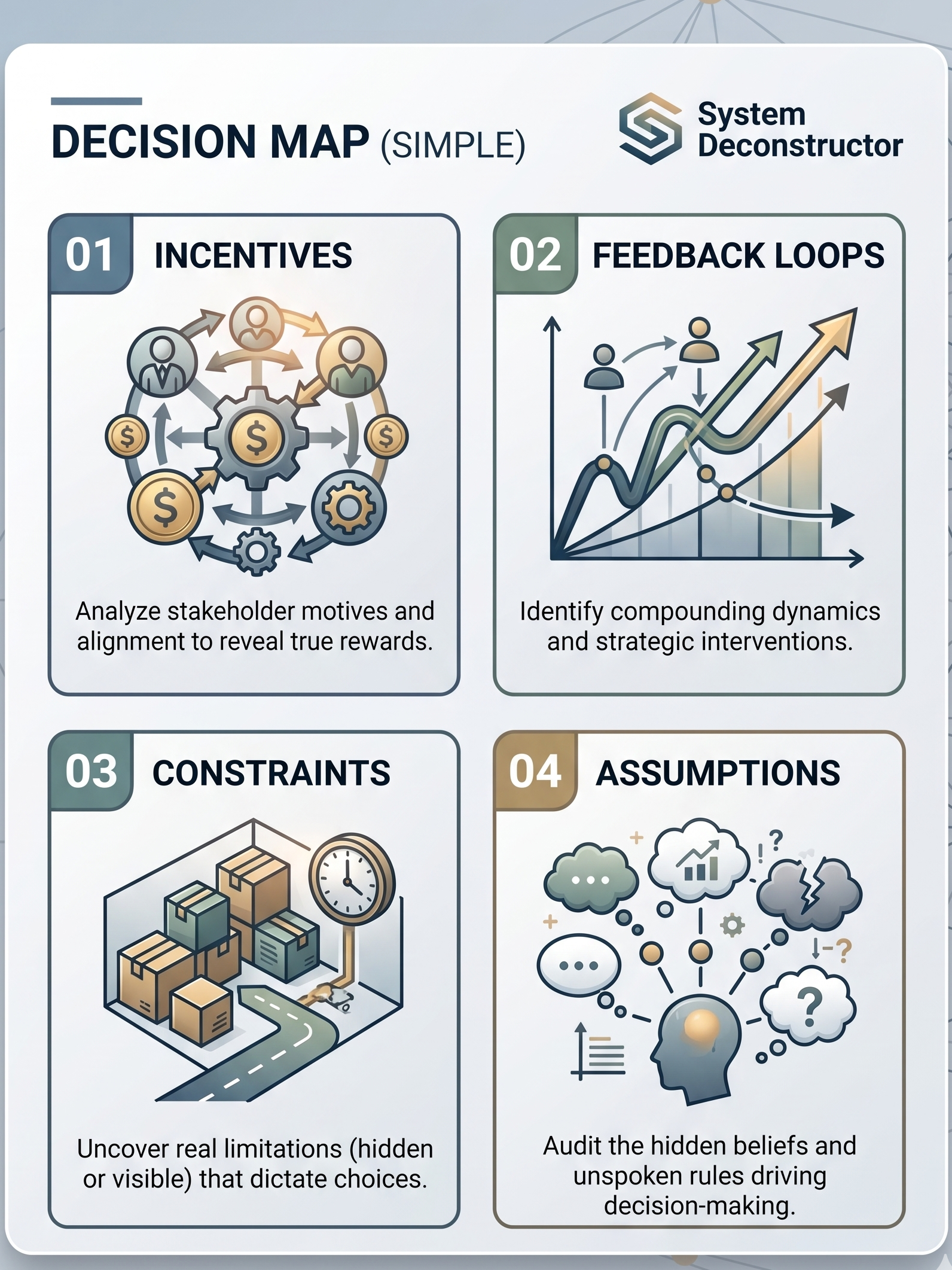
    A proper decision map has four components. Most analysis covers none of them.

    1. Stakeholder Incentives (Real Ones)

    Not what people say they want. What they actually need.

    The vendor needs margin. The internal champion needs a win before year-end review. The CFO needs to look fiscally responsible. The end users need something that doesn’t break on Friday afternoon.

    These are four different problems wearing the same costume. If you optimize for one, you alienate the others. If you map all four, you find the move that satisfies enough of them to get to yes.

    2. Feedback Loops

    What compounds over time — positively and negatively?

    The “safe” choice often looks safe in month one. By month eighteen, the technical debt from that safe choice has compounded into a rebuild. The “risky” choice that required organizational change in month one would have compounded into a competitive advantage by now.

    Pros and cons lists are static. Systems move. The decision you make today creates the conditions for every decision you’ll make for the next three years.

    3. Hidden Assumptions

    Every decision rests on a set of beliefs the decision-maker has never examined.

    “We need to move fast.” Do you? Or does it feel urgent because someone upstream is anxious?

    “The market won’t pay more than X.” Based on what? A price test you ran two years ago in a different economic environment?

    “Our team can’t handle the transition.” Have you asked them? Or are you projecting last year’s failure onto this year’s team?

    Hidden assumptions are load-bearing walls in the architecture of your decision. Pull the wrong one out and the whole structure collapses — but you won’t know which one it is until someone maps them.

    4. The Real Constraint

    This is the most important and most consistently ignored element.

    Every decision has one constraint that makes everything else irrelevant until it’s resolved. Not the most visible constraint. The one underneath it.

    In the infrastructure example: the real constraint wasn’t budget or timeline or technical requirements. It was the procurement team’s relationship with the incumbent vendor — a relationship that made any competing bid feel like a betrayal rather than a business decision.

    Fix the relationship dynamic first. Everything else becomes negotiable.

    The Leverage Point

    When you map the system — stakeholders, loops, assumptions, constraints — something becomes visible that wasn’t before:

    The leverage point. The single intervention that changes the outcome without requiring you to fight the entire system.

    In physics, a lever lets you move a heavy object with minimal force — but only if you place it at the right point. The same principle applies to decisions.

    Most people try to push the whole system. The leverage point lets you move the one thing that moves everything else.

    It’s almost always smaller than you expect. It’s almost never the most obvious thing in the room.

    How to Find It

    Ask these five questions before any significant decision:

    1. Who actually benefits from each possible outcome — and are their incentives aligned with yours?
    2. What are the feedback loops? What compounds over time if you choose A versus B?
    3. What are you assuming that you haven’t examined?
    4. What is the one constraint that makes everything else secondary?
    5. Where is the smallest intervention that creates the largest shift?

    You don’t need a framework to ask these questions. But a framework makes you ask them every time — not just when the stakes are high enough to slow down.

    What We Built

    We’ve spent months turning this process into a tool.

    Lever is a decision intelligence platform that runs any decision through the System Deconstructor framework — mapping stakeholders, incentives, feedback loops, hidden assumptions, and constraints — and surfaces one leverage point with a recommended first move.

    It works on anything. Career decisions. Investment calls. Vendor selection. Organizational restructuring. Whether to start the company. Whether to end the partnership.

    The system is always there. Lever makes it visible.

    Early access is open now at theai-4u.com/lever.

    The free tier gives you three deconstructions. No credit card. No commitment.

    If you’re facing a decision right now that you can’t quite see clearly — start there.


    Wave is a Senior Technical Orchestrator and AI systems architect. This post is part of an ongoing series on decision intelligence, AI agent deployment, and building profitable systems that genuinely help people. More at theai-4u.com.

  • From Chat to Action: Why I Went Dark — and What I Built While You Were Prompting

    Hey AI Innovators — welcome back.

    If you’ve been following this site, you may have noticed it’s been quiet for a while. No new posts. No new series. Just silence.

    I owe you an explanation. And honestly, the explanation is the post.

    I Stopped Writing Because I Started Building

    For most of 2024 and into 2025, I was doing what a lot of us were doing — reading about AI, experimenting with AI, writing about AI. Watching the landscape evolve in real time. Tracking model releases. Testing tools. Sharing what I found.

    And then something shifted.

    Not in the technology. In me.

    At some point I realized I wasn’t using AI — I was consuming it. Prompting things into existence, reading the output, closing the tab. It was intellectually interesting. It was practically useless.

    The problem wasn’t the tools. The problem was the paradigm.

    The Paradigm Shift Nobody’s Talking About Loudly Enough

    For the last few years, the dominant mental model for AI has been: you ask, it answers.

    You type a prompt. The model responds. You read it, maybe copy it, maybe act on it yourself. Repeat.

    That’s the chat paradigm. And it’s already obsolete.

    The new paradigm is: you define a goal, and the agent executes it.

    Not generates text about it. Not summarizes it. Executes it. Autonomously. While you’re doing something else.

    The difference between these two paradigms isn’t incremental. It’s architectural. And most people — including a lot of technical people — are still operating in the old one.

    I know because I was one of them.

    What Changed for Me

    About nine months ago, I started rebuilding how I work with AI from the ground up. Not using cloud-hosted chat interfaces. Not pasting prompts into a browser tab. Building actual infrastructure — local, secure, zero-trust — where an AI agent could operate with real autonomy and real oversight.

    I spent months doing what I used to write about: sitting at the intersection of AI capability and real-world deployment. Figuring out what actually works when the agent has file system access, internet access, and the ability to execute terminal commands on your hardware.

    What I found changed my perspective on almost everything.

    The good news: The capability is real. Genuine autonomous action — the kind where you describe an outcome and the agent executes a multi-step workflow to deliver it — is not a demo. It’s operational. I’m running it daily.

    The harder news: Most people aren’t set up for it. Not because the technology is too complex, but because the security foundations aren’t there. Giving an autonomous agent unrestricted access to your machine without the right containment architecture isn’t productivity — it’s a liability.

    The gap between “AI chat user” and “AI infrastructure operator” is larger than most people think. But it’s also very crossable. I crossed it. And I’m going to show you exactly how.

    What’s Coming Next on This Site

    The new focus is operational AI. Not “here are 10 prompts to try.” Not “here’s what the latest model can do.” Practical, production-grade guidance for people who are ready to stop prompting and start building.

    The posts coming up will cover what I’ve actually been doing in the field — the infrastructure decisions, the security tradeoffs, the tools that deliver real results, and the ones that don’t. No hype. No vendor pitches. Just what works.

    If you’ve been following this site from the beginning, the lens is shifting. Same commitment to making AI accessible and practical — but the conversation is moving up the stack. We’re going to talk about how you actually deploy this stuff, run it reliably, and keep it under control.

    If that’s the direction you want to go, subscribe and stay close. Things are moving fast and I don’t plan to slow down.


    The chat era was useful. It taught us what these models could do.

    The action era is what actually changes how you work.

    I’ll see you in the next post.

    — The AI-4U


    Want to see how this was built?

    Explore the full Wave agent architecture — multiple specialized agents, structured memory files, zero-trust security. See How Wave Works →

  • The AI Revolution in Tech: My Journey and Your Invitation

    The AI Revolution in Tech: My Journey and Your Invitation

    Hello, AI enthusiasts! I’m thrilled to welcome you to theAI-4u.com, a space dedicated to demystifying the world of Artificial Intelligence for tech professionals. This marks the beginning of a journey, and I’m excited to have you join me.

    My Journey into the AI Realm

    My journey into the realm of AI began with simple prompts using OpenAI and Gemini. But the real exploration happened late at night, fueled by countless YouTube videos. With two young children, time is a precious commodity, and those videos allowed me to quickly absorb a vast amount of information. Like many of you, I’ve witnessed the rapid evolution of AI, from theoretical concepts to practical applications that are reshaping our industry. With over 12 years in software design, I’ve been a firsthand observer of AI’s transformative impact on how we build and deploy technology. And now, I’m applying what I’ve learned, both at work and in my day-to-day life.

    Why This Blog?

    The AI landscape can be overwhelming. There’s a constant influx of new tools, technologies, and jargon. My goal is to cut through the noise and provide you with actionable insights and practical advice that you can apply in your daily work.

    What You Can Expect

    Here’s what you can expect from theai-4u.com:

    • Practical AI Tools: We’ll explore the latest AI tools and platforms that can streamline your development process.
    • Real-World Applications: We’ll dive into real-world examples of how AI is being used in software development.
    • Tutorials and Guides: We’ll provide step-by-step tutorials and guides to help you implement AI solutions.
    • Community and Collaboration: We’ll foster a community where we can learn from each other and share our experiences.

    An Invitation to Join the Revolution

    The AI revolution is here, and it’s transforming the tech industry at an unprecedented pace. I invite you to join me on this journey as we explore the limitless possibilities of AI.

    Let’s Connect!

    I’d love to hear from you. What are your biggest challenges and questions regarding AI? What topics would you like me to cover?

    • Leave a comment below.
    • Subscribe to our newsletter for the latest updates.

    The Future is AI

    Thank you for being a part of this community. Together, we can unlock the potential of AI and shape the future of technology.