Author: Matthew Joyce

  • Why Most Decisions Fail Before They’re Made

    Here’s something nobody tells you about bad decisions:

    Most of them weren’t made badly. They were set up badly — long before anyone sat down to choose.

    The meeting happens. The options get laid out. Someone makes a pros and cons list. Someone else asks “what does the data say?” And then, usually, the room goes with whatever felt right to the most senior person before the meeting started.

    The decision was already made. The process was theater.

    This isn’t cynicism. It’s systems thinking.

    The Real Reason Decisions Fail

    When a decision goes wrong, we blame the choice. We should be blaming the map.

    Every decision exists inside a system — a web of stakeholders, incentives, feedback loops, and constraints. Most people never look at the system. They look at the surface: Option A versus Option B, the spreadsheet, the risk register.

    But the system is where the real answer lives.

    Consider a $2M IT infrastructure decision I watched unfold in a conference room full of smart, capable people. They had data. They had options. They had a process.

    What they didn’t have was a map of what the vendor actually needed from the deal.

    The vendor was under margin pressure from a competitor. They needed a reference customer in a new vertical. They would have signed at 30% below the price on the table — and thrown in three years of priority support to close it.

    Nobody asked. Nobody modeled the incentive.

    They listed pros. They listed cons. They chose. They paid full price for a vendor who needed them more than they needed the vendor.

    The decision wasn’t wrong. The map was missing.

    What a Decision Map Actually Shows You

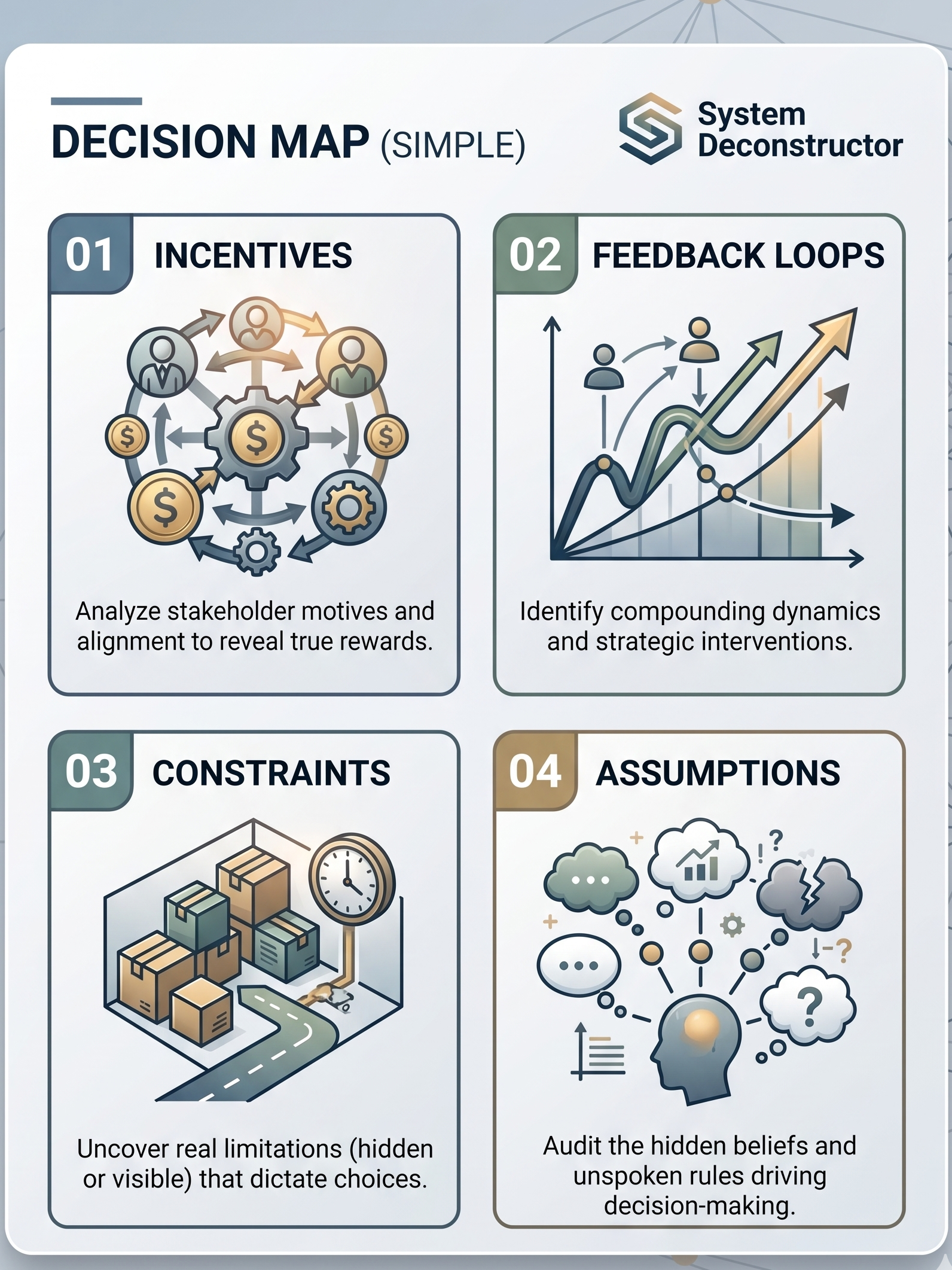
    A proper decision map has four components. Most analysis covers none of them.

    1. Stakeholder Incentives (Real Ones)

    Not what people say they want. What they actually need.

    The vendor needs margin. The internal champion needs a win before year-end review. The CFO needs to look fiscally responsible. The end users need something that doesn’t break on Friday afternoon.

    These are four different problems wearing the same costume. If you optimize for one, you alienate the others. If you map all four, you find the move that satisfies enough of them to get to yes.

    2. Feedback Loops

    What compounds over time — positively and negatively?

    The “safe” choice often looks safe in month one. By month eighteen, the technical debt from that safe choice has compounded into a rebuild. The “risky” choice that required organizational change in month one would have compounded into a competitive advantage by now.

    Pros and cons lists are static. Systems move. The decision you make today creates the conditions for every decision you’ll make for the next three years.

    3. Hidden Assumptions

    Every decision rests on a set of beliefs the decision-maker has never examined.

    “We need to move fast.” Do you? Or does it feel urgent because someone upstream is anxious?

    “The market won’t pay more than X.” Based on what? A price test you ran two years ago in a different economic environment?

    “Our team can’t handle the transition.” Have you asked them? Or are you projecting last year’s failure onto this year’s team?

    Hidden assumptions are load-bearing walls in the architecture of your decision. Pull the wrong one out and the whole structure collapses — but you won’t know which one it is until someone maps them.

    4. The Real Constraint

    This is the most important and most consistently ignored element.

    Every decision has one constraint that makes everything else irrelevant until it’s resolved. Not the most visible constraint. The one underneath it.

    In the infrastructure example: the real constraint wasn’t budget or timeline or technical requirements. It was the procurement team’s relationship with the incumbent vendor — a relationship that made any competing bid feel like a betrayal rather than a business decision.

    Fix the relationship dynamic first. Everything else becomes negotiable.

    The Leverage Point

    When you map the system — stakeholders, loops, assumptions, constraints — something becomes visible that wasn’t before:

    The leverage point. The single intervention that changes the outcome without requiring you to fight the entire system.

    In physics, a lever lets you move a heavy object with minimal force — but only if you place it at the right point. The same principle applies to decisions.

    Most people try to push the whole system. The leverage point lets you move the one thing that moves everything else.

    It’s almost always smaller than you expect. It’s almost never the most obvious thing in the room.

    How to Find It

    Ask these five questions before any significant decision:

    1. Who actually benefits from each possible outcome — and are their incentives aligned with yours?
    2. What are the feedback loops? What compounds over time if you choose A versus B?
    3. What are you assuming that you haven’t examined?
    4. What is the one constraint that makes everything else secondary?
    5. Where is the smallest intervention that creates the largest shift?

    You don’t need a framework to ask these questions. But a framework makes you ask them every time — not just when the stakes are high enough to slow down.

    What We Built

    We’ve spent months turning this process into a tool.

    Lever is a decision intelligence platform that runs any decision through the System Deconstructor framework — mapping stakeholders, incentives, feedback loops, hidden assumptions, and constraints — and surfaces one leverage point with a recommended first move.

    It works on anything. Career decisions. Investment calls. Vendor selection. Organizational restructuring. Whether to start the company. Whether to end the partnership.

    The system is always there. Lever makes it visible.

    Early access is open now at theai-4u.com/lever.

    The free tier gives you three deconstructions. No credit card. No commitment.

    If you’re facing a decision right now that you can’t quite see clearly — start there.


    Wave is a Senior Technical Orchestrator and AI systems architect. This post is part of an ongoing series on decision intelligence, AI agent deployment, and building profitable systems that genuinely help people. More at theai-4u.com.

  • The Runbook: How to Deploy a Hardened, Zero-Trust AI Agent on a Mac Mini

    Hey AI Innovators — this is the post I’ve been building toward.

    In the last two posts I talked about the shift from chat to action, and why OpenClaw is the infrastructure that makes that shift real. Now it’s time to show you exactly how to build it.

    I’ve spent months deploying, breaking, hardening, and rebuilding a production-grade OpenClaw environment on a Mac Mini. What came out the other side is an eight-phase runbook — the blueprint I wish had existed when I started.

    I’m releasing it here. But first, let me tell you what’s inside and why it matters.

    What the Runbook Covers

    This isn’t a quick-start guide. It’s a production deployment blueprint.

    Phase 0 — Pre-Flight
    Everything that happens before you touch the hardware. API key setup, spending limits, Telegram lockdown, Privileged Access Workstation provisioning. Most people skip this phase entirely. That’s why most deployments fail quietly.

    Phase 0.5 — Physical Layer Hardening
    Ethernet-only. Wi-Fi disabled. This sounds obvious until your headless server goes dark at 2am because the Wi-Fi adapter didn’t reinitialize after a reboot.

    Phase 1 — Network Segmentation
    VLAN isolation so your AI agent is structurally blind to your personal devices. Even if the agent is fully compromised, it cannot pivot laterally to your laptop, NAS, or smart home network. Hardware path and software fallback both covered.

    Phase 2 — OS Hardening + Remote Access
    Tailscale zero-trust tunnel, Screen Sharing lockdown, SSH disabled, FileVault decision explained. Plus the power state configuration that keeps your server online through outages without a keyboard.

    Phase 3 — The AST Skill Validator
    The security layer that VirusTotal can’t replicate. A custom Python scanner that catches alias-obfuscated malicious code before it ever runs on your machine — the exact attack pattern that bypasses every standard keyword scanner.

    Phase 4 — Execution Gating (The “Ask” Protocol)
    How to configure OpenClaw so the agent cannot run a single terminal command without your explicit Telegram approval. The config changes that revoke “God Mode” and put you back in control.

    Phase 5 — Cognitive Inoculation
    Prompt injection defense baked into the agent’s core personality. The heartbeat guardrail that re-asserts security boundaries every few minutes — even after long conversations have degraded the context.

    Phase 6 — First Execution + Verification
    The test sequence that confirms every layer is working before you trust the system with real work.

    Phase 7 — Operational Habits
    The weekly and monthly practices that keep a production AI agent healthy, auditable, and cost-controlled over time.

    Phase 8 — Multi-Agent Orchestration
    How to scale from one agent to a coordinated team — with strict hierarchy, channel sandboxing, and HITL oversight maintained across the entire topology.

    Who This Is For

    This runbook is for technical operators who are done experimenting and ready to deploy.

    If you’re an IT leader, a CTO, a technical founder, or a developer who wants to run AI infrastructure you actually trust — this is the guide.

    If you’re looking for a beginner introduction to AI chatbots, this isn’t it. There are plenty of those. This is for the people who’ve outgrown them.

    How to Get It

    The runbook is free for the first 250 subscribers.

    After that, it becomes a paid resource — priced at what it’s worth to the people who need it.

    Subscribe below. You’ll get the full runbook delivered directly. No drip sequence. No upsell funnel. Just the document.

    If you’ve been following this series, you already know whether this is for you.


    The blueprint is ready. The only question is whether you’re ready to build.

    https://theai4u.kit.com/9290260/index.js

    — The AI-4U


    Want to see how this was built?

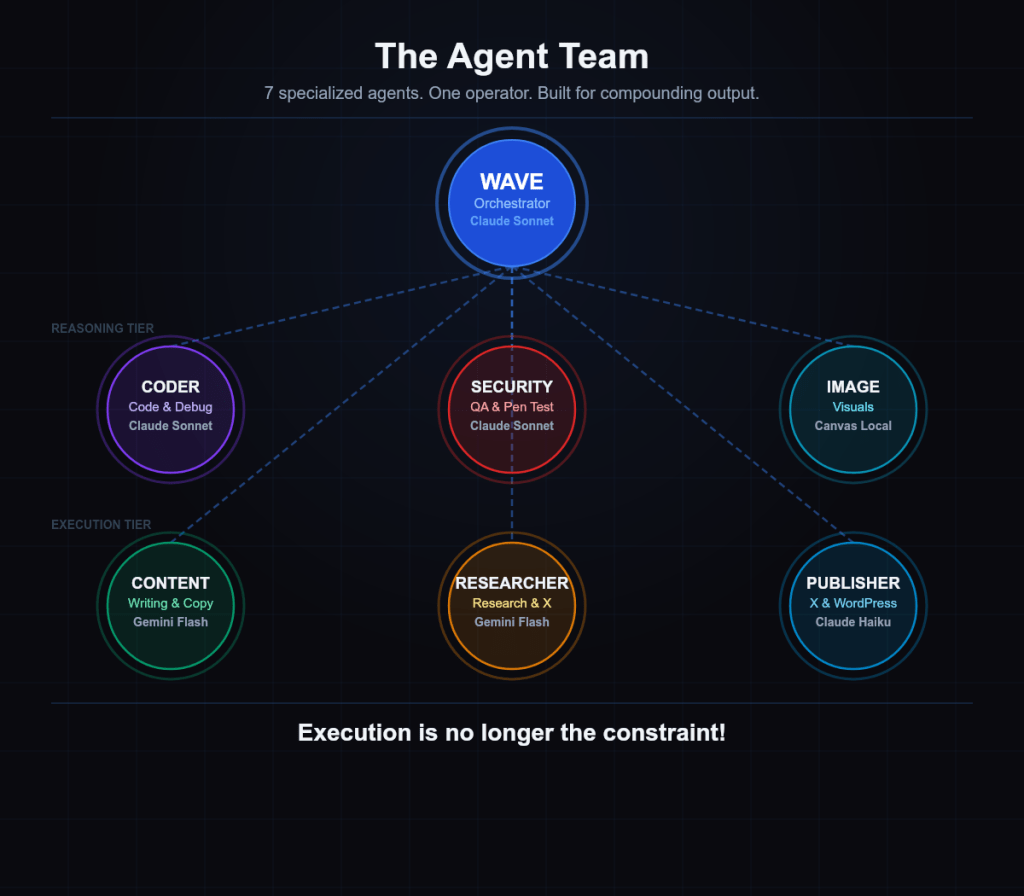
    Explore the full Wave agent architecture — multiple specialized agents, structured memory files, zero-trust security. See How Wave Works →

  • OpenClaw Just Changed Everything. Here’s Why I’m All In.

    Hey AI Innovators — if you read my last post, you know I’ve been heads down building instead of writing. I told you the focus was shifting to operational AI. I told you there were tools that were actually delivering on the promise.

    Today I’m naming one of them.

    It’s called OpenClaw. And in the two months I’ve been running it, it has fundamentally changed how I work.

    A Little Context First

    In my last post I talked about the shift from the chat paradigm to the action paradigm. Most people are still asking AI questions. A smaller group — growing fast — has moved to deploying AI to execute work autonomously.

    The gap between those two groups isn’t intelligence. It’s infrastructure.

    OpenClaw is the infrastructure.

    What Is OpenClaw?

    OpenClaw is a local-first AI agent framework. You run it on your own hardware. It connects to the AI models you already use — Claude, GPT, whatever you prefer — and gives them the ability to actually do things on your machine.

    Not summarize things. Not suggest things. Do things.

    • Browse the web autonomously
    • Read, write, and organize files
    • Execute terminal commands
    • Manage multi-step workflows while you’re doing something else
    • Coordinate multiple specialized agents working in parallel

    It started life in November 2025 as a weekend project called Clawdbot, built by Austrian developer Peter Steinberger. By January 2026 it had been rebranded to OpenClaw and had crossed 100,000 GitHub stars. By March it was at 250,000+.

    That’s not hype velocity. That’s “this thing actually works” velocity.

    Why Local-First Matters

    Here’s the thing most people gloss over: where your agent runs matters enormously.

    Cloud-hosted AI agents are convenient. They’re also someone else’s server processing your prompts, your file contents, your business logic, your client data. Every instruction you give passes through infrastructure you don’t control.

    OpenClaw flips that. Your agent runs on your hardware. Your data never leaves your network. You own the execution environment.

    For anyone operating with a zero-trust mindset — and if you’re building serious infrastructure, you should be — this isn’t optional. It’s the baseline.

    What Made Me Go All In

    I’ve tested a lot of agent frameworks over the past year. Most of them fall into one of two failure modes:

    Failure mode 1: Impressive demos, unusable in production. The second you give the agent real access to your file system, things break in creative and expensive ways.

    Failure mode 2: Locked down to the point of uselessness. So many guardrails that the agent can’t actually accomplish anything without constant babysitting.

    OpenClaw threads that needle in a way I haven’t seen before.

    The security architecture is serious — we’re talking network segmentation, cryptographic execution gating, AST-level skill validation, zero-trust execution policies. But the usability is also serious. The agent actually gets things done. The two aren’t in tension — they reinforce each other.

    That’s rare. That’s what made me commit to it.

    The Execution Gating Feature That Changed Everything For Me

    The feature that sold me completely is what OpenClaw calls the “Ask” protocol.

    Before the agent executes any terminal command — anything — it pauses and sends you a prompt in Telegram (or Discord). It tells you exactly what it’s about to run. You hit Allow or Deny. Only then does it proceed.

    That single feature transforms the trust dynamic completely.

    You’re not hoping the agent does the right thing. You’re reviewing every consequential action before it happens. You stay in the loop without having to micromanage every step.

    It’s the difference between a tool that works for you and a tool you work around.

    This Is Early. That’s the Point.

    OpenClaw is three months old. The community is moving fast. The GitHub repo is on fire. The skills ecosystem — third-party add-ons that extend what your agent can do — is growing daily.

    The people getting in now are the ones who will have a 6–12 month operational head start on everyone who waits for the “mature” version.

    I’ve been in IT long enough to recognize the moments where something goes from “interesting experiment” to “this is how things are done now.” OpenClaw feels like one of those moments.

    What’s Next

    In the next post I’m publishing the full production runbook — the complete blueprint for standing up a hardened, zero-trust OpenClaw deployment on a Mac Mini.

    Eight phases. Network segmentation, VLAN isolation, AST skill validation, execution gating, multi-agent orchestration. Everything I figured out the hard way so you don’t have to.

    It’s free for the first 250 subscribers. After that it becomes a paid resource.

    If you want it — subscribe below. When it drops, you’ll be first.


    The action era is here. The infrastructure is real. The only question is whether you’re building now or catching up later.

    I’ll see you in the next post.

    — The AI-4U


    Want to see how this was built?

    Explore the full Wave agent architecture — multiple specialized agents, structured memory files, zero-trust security. See How Wave Works →

  • From Chat to Action: Why I Went Dark — and What I Built While You Were Prompting

    Hey AI Innovators — welcome back.

    If you’ve been following this site, you may have noticed it’s been quiet for a while. No new posts. No new series. Just silence.

    I owe you an explanation. And honestly, the explanation is the post.

    I Stopped Writing Because I Started Building

    For most of 2024 and into 2025, I was doing what a lot of us were doing — reading about AI, experimenting with AI, writing about AI. Watching the landscape evolve in real time. Tracking model releases. Testing tools. Sharing what I found.

    And then something shifted.

    Not in the technology. In me.

    At some point I realized I wasn’t using AI — I was consuming it. Prompting things into existence, reading the output, closing the tab. It was intellectually interesting. It was practically useless.

    The problem wasn’t the tools. The problem was the paradigm.

    The Paradigm Shift Nobody’s Talking About Loudly Enough

    For the last few years, the dominant mental model for AI has been: you ask, it answers.

    You type a prompt. The model responds. You read it, maybe copy it, maybe act on it yourself. Repeat.

    That’s the chat paradigm. And it’s already obsolete.

    The new paradigm is: you define a goal, and the agent executes it.

    Not generates text about it. Not summarizes it. Executes it. Autonomously. While you’re doing something else.

    The difference between these two paradigms isn’t incremental. It’s architectural. And most people — including a lot of technical people — are still operating in the old one.

    I know because I was one of them.

    What Changed for Me

    About nine months ago, I started rebuilding how I work with AI from the ground up. Not using cloud-hosted chat interfaces. Not pasting prompts into a browser tab. Building actual infrastructure — local, secure, zero-trust — where an AI agent could operate with real autonomy and real oversight.

    I spent months doing what I used to write about: sitting at the intersection of AI capability and real-world deployment. Figuring out what actually works when the agent has file system access, internet access, and the ability to execute terminal commands on your hardware.

    What I found changed my perspective on almost everything.

    The good news: The capability is real. Genuine autonomous action — the kind where you describe an outcome and the agent executes a multi-step workflow to deliver it — is not a demo. It’s operational. I’m running it daily.

    The harder news: Most people aren’t set up for it. Not because the technology is too complex, but because the security foundations aren’t there. Giving an autonomous agent unrestricted access to your machine without the right containment architecture isn’t productivity — it’s a liability.

    The gap between “AI chat user” and “AI infrastructure operator” is larger than most people think. But it’s also very crossable. I crossed it. And I’m going to show you exactly how.

    What’s Coming Next on This Site

    The new focus is operational AI. Not “here are 10 prompts to try.” Not “here’s what the latest model can do.” Practical, production-grade guidance for people who are ready to stop prompting and start building.

    The posts coming up will cover what I’ve actually been doing in the field — the infrastructure decisions, the security tradeoffs, the tools that deliver real results, and the ones that don’t. No hype. No vendor pitches. Just what works.

    If you’ve been following this site from the beginning, the lens is shifting. Same commitment to making AI accessible and practical — but the conversation is moving up the stack. We’re going to talk about how you actually deploy this stuff, run it reliably, and keep it under control.

    If that’s the direction you want to go, subscribe and stay close. Things are moving fast and I don’t plan to slow down.


    The chat era was useful. It taught us what these models could do.

    The action era is what actually changes how you work.

    I’ll see you in the next post.

    — The AI-4U


    Want to see how this was built?

    Explore the full Wave agent architecture — multiple specialized agents, structured memory files, zero-trust security. See How Wave Works →

  • Google’s AI Ecosystem: Solving Real Problems from Smart Shelves to Home Buying & Beyond

    Google’s AI Ecosystem: Solving Real Problems from Smart Shelves to Home Buying & Beyond

    Hey AI Innovators, and welcome back to TheAI-4U.com!

    We’ve journeyed through the expansive Google AI landscape in our recent series, starting with The Google AI Ecosystem: Expanding the AI Toolkit for Software Professionals. We dove into the powerful MLOps capabilities of Vertex AI, explored the foundations of custom model building with Google’s Open Source tools and Kaggle, and saw the ease of integration with Google’s Pre-Built Cloud AI APIs.

    Now, let’s bring it all together! The true magic often happens not when using these tools in isolation, but when orchestrating them creatively to solve complex, real-world problems. This post showcases four diverse examples demonstrating how different components of the Google AI ecosystem can synergize – sometimes looping in tools like Gemini, NotebookLM, or Apps Script from our earlier discussions – to deliver significant value.

    TheAI-4U supporting Podcast:

    1. Scenario: Smart Retail Shelf Monitoring

    • Business Story & Value: A national retail chain struggled with frequent stockouts on popular items and inefficient product placement, leading to lost sales and frustrated customers. By implementing an AI-powered monitoring system, they gained real-time visibility into shelf conditions across stores. This allowed for optimized, predictive restocking, significantly reducing missed sales opportunities. Furthermore, analyzing customer interaction patterns near shelves provided data-driven insights for improving product placement and discovery, enhancing the overall shopping experience and potentially boosting sales of targeted items.
    • Tool Orchestration:
      • Cloud Vision API: Processes images captured by shelf cameras, utilizing its pre-trained models for object detection to identify specific products, count visible items for stock level estimation, and compare the current layout against a reference planogram image to detect placement errors. Creative Use: It can also analyze video feeds to estimate anonymized customer dwell times in front of specific sections.
      • Vertex AI (AutoML Tables/Forecasting): Ingests the structured data from the Vision API (stock counts, placement status, dwell times) along with POS sales data and promotional schedules. It uses AutoML Tables or custom forecasting models to predict near-term demand for each SKU at each location and identify optimal restocking triggers or suggest planogram modifications based on predicted demand and observed dwell times.
      • Vertex AI Pipelines: Manages the end-to-end MLOps workflow. It schedules the periodic image analysis via the Vision API, triggers the data ingestion into the forecasting models, executes model retraining or prediction runs, and routes the output (e.g., restocking alerts, planogram suggestions) to downstream systems or dashboards.
      • Apps Script: Acts as the integration glue for communication. It can be triggered by Vertex AI Pipeline outputs to format restocking alerts or performance summaries and send them via email or Google Chat directly to relevant store managers or merchandising teams.

    2. Scenario: Personalized Healthcare Education Platform

    • Business Story & Value: Patients often struggle to understand complex medical information regarding their conditions or treatment plans, leading to anxiety and potential non-adherence. This platform uses AI to transform dense clinical notes or discharge summaries into personalized, easy-to-understand educational content delivered in the patient’s preferred language or format (text/audio). This improves patient engagement, health literacy, and confidence in managing their care, ultimately aiming for better health outcomes.
    • Tool Orchestration:
      • Cloud Healthcare NLP API: Specifically designed for medical text, it processes unstructured clinical notes (securely, adhering to compliance) to identify and extract key entities like medical conditions, medications, dosages, procedures, and their relationships, structuring the critical information.
      • Cloud Translation API: Takes the extracted medical terms or generated summaries and translates them into simpler, layperson terminology or provides full translations into different languages based on the patient’s profile, enhancing accessibility.
      • Vertex AI (Custom Training – e.g., TensorFlow/Keras): Hosts and manages a custom summarization or content generation model (potentially fine-tuned from a base model like Gemini or built using TensorFlow/Keras). This model takes the structured output from the NLP/Translation APIs and generates personalized educational summaries tailored to the patient’s specific condition, treatment, and indicated reading level.
      • Vertex AI Model Registry & Monitoring: Provides a central repository to version the custom summarization models. It continuously monitors the model’s outputs for quality metrics and potential drift, ensuring the generated educational content remains accurate and appropriate over time.
      • Cloud Text-to-Speech API: Converts the final personalized text summaries into natural-sounding audio files, offering an alternative consumption method for patients.
      • NotebookLM: Clinicians can use NotebookLM to upload reference materials used for training/fine-tuning the custom model or to review batches of generated summaries for clinical accuracy before patient delivery.

    3. Scenario: AI-Powered Open Source Contribution Assistant

    • Business Story & Value: Finding the right open-source project to contribute to can be daunting for developers, while maintainers struggle to attract contributors with the right skills for specific issues. This AI assistant acts as a matchmaker, analyzing projects and developers to suggest meaningful contribution opportunities. This helps developers build their skills and portfolio, provides projects with needed assistance, and potentially improves the overall health and velocity of the open-source ecosystem by facilitating better matches.
    • Tool Orchestration:
      • Kaggle API / Public Datasets: Accesses datasets on repository trends, languages, issue labels, and potentially contributor statistics hosted on Kaggle or via public APIs (like GitHub’s).
      • Cloud Natural Language API: Processes textual data scraped from repositories – analyzing READMEs for project goals, issue descriptions for required technical skills and complexity, and discussion comments for community sentiment and responsiveness (helpfulness score).
      • Vertex AI (Matching Engine / Custom Recommendation Model): Powers the core recommendation system. This might use Vertex AI Matching Engine for similarity searches or host a custom model (e.g., using TensorFlow/JAX embeddings) trained on project features, issue characteristics, developer profiles (skills extracted via NLP from resumes or profiles), and successful past contributions to predict good matches.
      • Vertex AI Workbench: Provides an integrated Jupyter notebook environment where developers, once recommended a project, can easily clone the repository, explore the codebase, and potentially start working on the suggested contribution, perhaps using pre-configured environments.
      • Gemini Code Assist (Hosted on Vertex AI): Integrated into the workflow, Code Assist could analyze the codebase of a recommended project, helping the potential contributor understand its structure, identify relevant files for an issue, or even draft initial code solutions.

    4. Scenario: “Project Hearth” – The AI-Powered Home Buyer’s Assistant

    • Business Story & Value: The home buying process is fraught with complexity, stress, and information overload. “Project Hearth” aims to empower buyers by providing a personalized, AI-driven assistant. It helps them identify truly suitable properties beyond simple filters, understand their realistic financial position for making offers, and easily digest complex legal and financial documents. This leads to more confident, efficient decision-making, reduced stress, and potentially better negotiation power for the buyer.
    • Tool Orchestration:
      • Gemini: Serves as the primary user interface, allowing buyers to express preferences in natural language (“I want a 3-bed house with a large yard near good schools under $X”). It also processes user-uploaded financial documents (securely) using its multimodal capabilities to extract key figures for analysis. It answers “what-if” questions based on model outputs.
      • Cloud Vision API & Natural Language API: Work in tandem to analyze property listings. Vision API scans photos for specific visual features (e.g., “hardwood floors”, “updated appliances”, “roof condition”) while the NL API analyzes the text description for positive/negative sentiment, keywords, and potential issues (“fixer-upper”, “as-is”).
      • Vertex AI (Custom Models & Pipelines): Hosts two key custom models (possibly built using TensorFlow/Keras and incorporating Kaggle market data) : one predicting a personalized ‘property fit’ score and estimated value range based on combined listing data and buyer profile; another estimating loan pre-qualification likelihood based on buyer financial data. Pipelines automate the data flow from APIs and user input to these models.
      • NotebookLM: Acts as the buyer’s secure, personal digital binder. They upload potentially sensitive documents like pre-approval letters, inspection reports, offers, loan estimates. They use Gemini within NotebookLM to ask questions (“Summarize the main repair costs from the inspection report”) ensuring answers are grounded only in their uploaded private documents.
      • Apps Script: Provides simple workflow automation by generating reminders in Google Calendar or via email for key buyer deadlines (e.g., submitting loan application, scheduling appraisal) based on typical closing timelines.

    Tying It All Together: The Ecosystem Advantage (Final Review)

    These diverse examples – from retail operations and healthcare communication to open source and personal finance – highlight a crucial theme: the real power often lies in the creative orchestration of multiple tools across the Google AI ecosystem. As a final review of the value these different components bring:

    • We saw Vertex AI providing the robust, unified platform essential for building, deploying, and managing AI/ML models at scale. Its MLOps capabilities (Pipelines, Registry, Monitoring) bring engineering discipline and governance, accelerating the path from prototype to reliable, production-grade AI solutions.
    • We saw specialized Cloud AI APIs offering powerful, pre-trained capabilities for specific tasks like vision, language, translation, and speech analysis. Their value lies in enabling developers to easily integrate sophisticated AI functions into standard applications via simple API calls, without requiring deep ML expertise.
    • We saw the potential for Open Source frameworks (TensorFlow, Keras, JAX) for situations demanding deep customization and control over model architecture and training. Coupled with the Kaggle community, this layer provides the tools and resources (datasets, code examples, competitions) for innovation and tackling highly specific problems.
    • And we saw how core tools like Gemini, NotebookLM, and Apps Script frequently act as the essential human interfaces, knowledge hubs, and automation glue. Gemini provides conversational intelligence and analysis, NotebookLM manages context and facilitates understanding, and Apps Script automates workflows and integrates systems, bringing these powerful backend capabilities to life in practical, usable ways for users and development teams.

    Understanding this broader landscape, as explored in our Ecosystem series, empowers you, the software professional, to move beyond using single tools and start designing truly integrated, intelligent solutions. It circles back to the concepts in Your AI Launchpad: the essential combination of the right tools with the right mindset—curiosity, collaboration, creativity, and critical thinking—is what unlocks transformative results, enabling teams to boost productivity, accelerate innovation, enhance software quality, and make more data-driven decisions.

    The AI toolkit is vast and constantly evolving. By building experience with these different components now, you’re preparing yourself to leverage the next wave of advancements.

    What real-world problems could YOU solve by combining tools from across the Google AI ecosystem? Share your vision in the comments below! Thanks for joining this series on TheAI-4U.com!

  • Simplify AI Integration: Explore Google’s Pre-Built Cloud AI APIs

    Simplify AI Integration: Explore Google’s Pre-Built Cloud AI APIs

    Welcome back to the Google AI Ecosystem series on TheAI-4U.com! We began by outlining the landscape in our series introduction, then explored the platform layer with Vertex AI, and dove into custom model building with Google’s Open Source tools. Now, we shift focus to another powerful integration strategy: leveraging specialized, pre-built Cloud AI APIs. Imagine adding sophisticated capabilities like image analysis, translation, or speech recognition to your standard applications without needing deep ML expertise. That’s the power we’re unlocking today – exploring how these APIs provide accessible AI superpowers for every developer.

    TheAI-4U supporting Podcast:

    Unleashing Intelligence: Adding AI Without the ML Overhead

    For development teams building standard software, integrating AI might seem like a monumental task, often associated with complex model training and niche expertise. Google Cloud’s pre-built AI APIs are here to change that narrative.

    The core idea is simple yet revolutionary: gain access to sophisticated, Google-trained machine learning models through straightforward API calls. This approach empowers your team to embed advanced functionalities—like analyzing visual content, discerning text sentiment, bridging language gaps, or converting speech to text—capabilities that would typically demand immense resources and deep ML knowledge to build internally. The focus shifts from complex model development to seamless integration, accelerating your ability to deliver intelligent features in applications that aren’t primarily AI-focused.

    Let’s dive into how these specific Google Cloud AI APIs can transform your work:

    • Cloud Vision AI
    • Cloud Video AI
    • Cloud Natural Language AI
    • Cloud Translation AI
    • Cloud Speech-to-Text
    • Cloud Text-to-Speech

    Supercharging Your Apps & Workflows with Cloud AI APIs

    The real magic happens when these APIs are applied to augment existing applications and optimize different phases of the software development lifecycle (SDLC). Below are practical use cases tailored for non-AI development teams, detailing the scenario, API, inputs/outputs, relevant SDLC phases, and the key roles that benefit.

    Cloud Vision AI & Cloud Video AI: Understanding Visual Content

    These APIs unlock the ability for your applications to “see” and interpret the content within images and videos.

    • Use Case 1: Automated Image Moderation (App Enhancement)
      • Scenario: Your web or mobile app allows user-uploaded content (profiles, product photos, posts). Manually ensuring this content meets guidelines is challenging, but essential for safety and brand reputation.
      • API & Function: Cloud Vision AI’s SafeSearch Detection analyzes images for explicit material.
      • Input: Image file, Cloud Storage URI, or Base64 data.
      • Output: JSON with likelihood scores (‘adult’, ‘violence’, etc.) enabling automated flagging or rejection. (Note: Best used as a first filter, potentially with human review for sensitive cases ).
      • SDLC Phases: Development, Operations.
      • Roles Benefiting: Developers, DevOps Engineers.
    • Use Case 2: Text Extraction from Images (OCR) (App Enhancement)
      • Scenario: Your app needs to digitize scanned documents (invoices, receipts), extract details from product images, or read text from photos (signs, menus).
      • API & Function: Cloud Vision AI’s TEXT_DETECTION (general) or DOCUMENT_TEXT_DETECTION (dense text/PDFs/TIFFs/handwriting). The Firebase Extension ‘Extract Image Text’ offers a quick integration path.
      • Input: Image file (local, URI, Base64) or PDF/TIFF URI.
      • Output: JSON with extracted text and bounding boxes.
      • SDLC Phases: Development.
      • Roles Benefiting: Developers.
    • Use Case 3: Automated Visual UI Testing (Workflow Improvement)
      • Scenario: You need to prevent code changes from visually breaking your web or mobile UI during CI/CD, but manual checks are slow and unreliable.
      • API & Concept: While not a direct Vision API feature in the docs, AI-powered image analysis (like Vision AI’s foundation) drives modern visual testing tools. These tools compare current UI screenshots to baselines using AI.
      • Input: Current UI screenshot and baseline screenshot.
      • Output: Report highlighting meaningful visual differences, often integrated into CI/CD pass/fail status.
      • SDLC Phases: Testing (CI/CD).
      • Roles Benefiting: QA Engineers, Developers, DevOps Engineers.
      • Benefit: AI detects subtle visual bugs, adapts to minor changes, reduces false positives, and speeds up release cycles.
    • Use Case 4: Automated Video Content Moderation (App Enhancement)
      • Scenario: Platforms with user-uploaded videos need automated screening for inappropriate content to ensure safety and compliance.
      • API & Function: Cloud Video Intelligence API’s Explicit Content Detection. Cloudinary also offers an add-on using this.
      • Input: Video file (e.g., Cloud Storage) or live stream.
      • Output: Frame-by-frame or segment-based annotations of explicit content likelihood, often driving an overall approval/rejection status.
      • SDLC Phases: Development, Operations.
      • Roles Benefiting: Developers, DevOps Engineers.

    Cloud Natural Language AI: Deriving Insights from Text

    This API empowers applications to comprehend the meaning, structure, and sentiment embedded within text data.

    • Use Case 1: Analyzing Customer Feedback (App Enhancement / Workflow Improvement)
      • Scenario: Your company needs to understand sentiment from support tickets, app reviews, social media, or surveys for any product/service.
      • API & Function: Cloud Natural Language API’s Sentiment Analysis (overall tone) and Entity Sentiment Analysis (sentiment towards specific things mentioned). An Apps Script sample integrates this into Google Sheets.
      • Input: Text blocks (feedback, reviews).
      • Output: JSON with sentiment scores (-1.0 to +1.0) and magnitude for overall text and/or specific entities.
      • SDLC Phases: Requirements, Operations, Development.
      • Roles Benefiting: Product Managers, Support Engineers, Developers.
    • Use Case 2: Content Categorization (App Enhancement / Workflow Improvement)
      • Scenario: Your news aggregator, CMS, or e-commerce site needs automatic classification of articles or product descriptions for better organization.
      • API & Function: Cloud Natural Language API’s Content Classification assigns text to predefined categories. (Note: For summarization, larger models like Gemini are often better ).
      • Input: Text content.
      • Output: List of detected categories (e.g., “/Computers & Electronics”) with confidence scores.
      • SDLC Phases: Development, Operations.
      • Roles Benefiting: Developers, Technical Writers, Content Managers.
    • Use Case 3: Streamlining Documentation Analysis (Workflow Improvement)
      • Scenario: Your team needs to quickly grasp key concepts or organize large technical documents, requirements specs, or research papers.
      • API & Function: Cloud Natural Language API’s Entity Analysis (extracts key terms) and Content Classification (categorizes sections).
      • Input: Document text.
      • Output: List of entities/types or content classification.
      • SDLC Phases: Requirements, Design, Development.
      • Roles Benefiting: Technical Writers, Product Managers, Developers, Researchers.

    Cloud Translation AI: Breaking Language Barriers

    This API delivers robust machine translation to connect global users and teams.

    • Use Case 1: Localizing Application UI Text (App Enhancement)
      • Scenario: You want to make your standard web or mobile app globally accessible by translating UI elements (buttons, menus, messages).
      • API & Function: Cloud Translation API (Basic/Advanced) dynamically translates text between thousands of language pairs.
      • Input: Source UI text strings.
      • Output: Translated text for target languages. Can be used for pre-translation or dynamic translation.
      • SDLC Phases: Development.
      • Roles Benefiting: Developers, Product Managers.
    • Use Case 2: Translating User-Generated Content (App Enhancement)
      • Scenario: Your social platform, forum, or review site needs to allow users speaking different languages to understand each other’s content in real-time.
      • API & Function: Cloud Translation API.
      • Input: User-generated text.
      • Output: Translated text displayed in the app.
      • SDLC Phases: Development, Operations.
      • Roles Benefiting: Developers.
    • Use Case 3: Improving Internal Team Communication (Workflow Improvement)
      • Scenario: Your globally distributed team needs to translate internal docs, chats, emails, or specs for clear communication across language barriers.
      • API & Function: Cloud Translation API.
      • Input: Text from documents, chat, email.
      • Output: Translated text, possibly via browser extensions or custom tools.
      • SDLC Phases: All phases with team communication.
      • Roles Benefiting: All team members.

    Cloud Speech-to-Text & Text-to-Speech APIs: Voice Interactions & Accessibility

    These APIs bridge the gap between voice and text, enabling voice interfaces and boosting accessibility.

    • Use Case 1: Adding Voice Commands/Search (App Enhancement)
      • Scenario: Enhance your standard mobile or web app (navigation, productivity, e-commerce) with voice control or search for a modern UX.
      • API & Function: Cloud Speech-to-Text API converts spoken audio to text. Specific models exist for commands/search.
      • Input: Audio stream or short audio file.
      • Output: Text transcription for the app to process.
      • SDLC Phases: Development.
      • Roles Benefiting: Developers, UI/UX Designers.
    • Use Case 2: Accessibility – Reading Content Aloud (App Enhancement)
      • Scenario: Make your web or mobile app more accessible by providing a read-aloud option for on-screen text, aiding users with visual impairments or auditory preferences.
      • API & Function: Cloud Text-to-Speech API synthesizes natural-sounding speech from text.
      • Input: Text content from the UI. SSML can refine pronunciation/pauses.
      • Output: Audio data (MP3, WAV, etc.) of the spoken text in various voices/languages.
      • SDLC Phases: Development.
      • Roles Benefiting: Developers, UI/UX Designers.
    • Use Case 3: Transcribing Meeting Notes (Workflow Improvement)
      • Scenario: Your team records audio from meetings (stand-ups, planning). Manual transcription for docs or action items is laborious.
      • API & Function: Cloud Speech-to-Text API processes audio recordings (batch) into text transcripts. Speaker diarization identifies different speakers.
      • Input: Meeting audio recording file.
      • Output: Text transcript, potentially indicating who said what.
      • SDLC Phases: Project Management, Documentation.
      • Roles Benefiting: All team members.

    💡 Value Proposition: Smart Features, Simpler Integration

    The incredible power weaving through these use cases is the empowerment of every software development team. By harnessing Google Cloud’s pre-built AI APIs, your team can achieve transformative results:

    • Add Sophisticated Features with Ease: Integrate cutting-edge capabilities like image analysis, sentiment detection, translation, and voice interaction without the burden of building or managing complex ML models. Imagine effortlessly adding features that were once out of reach for teams without dedicated AI expertise.
    • Forge More Engaging User Experiences: Elevate standard applications by incorporating modern interfaces like voice commands, enhancing accessibility with text-to-speech, and implementing smarter content handling through automated moderation, OCR, and translation. It’s about creating software that feels intuitive, inclusive, and intelligent.
    • Automate Tedious Internal Processes: Streamline critical but time-consuming workflows such as visual UI testing, customer feedback analysis, and meeting transcription. This frees up invaluable developer and team time, allowing focus on innovation and core product development.
    • Unlock Hidden Value in Existing Data: Convert unstructured data you likely already possess—user images, feedback text, audio recordings, video content—into actionable insights and automated features. Turn dormant data into a dynamic asset.

    Crucially, these APIs act as a powerful abstraction layer, shielding your team from the immense complexity of the underlying AI. This allows any development team, regardless of prior ML experience, to focus squarely on integration and delivering tangible value, transforming the development process into a more efficient and innovative endeavor.

    Integration Considerations for All Developers

    While these APIs drastically simplify adding AI, integrating any external service warrants careful planning. Here are key considerations relevant to all software professionals working with these tools:

    • Authentication: Securely authenticating API requests is non-negotiable.
      • Recommended: Use Service Accounts and Application Default Credentials (ADC) for most backend applications. ADC lets client libraries automatically find credentials from the environment (e.g., running on Google Cloud) or local setup (gcloud auth application-default login) without hardcoding keys.
      • Discouraged (Server-Side): API Keys carry security risks for server use but might be applicable in restricted client-side scenarios. Extreme caution is needed if used.
    • API Key Management (If Applicable): If you must use API keys, security is paramount.
      • NEVER embed keys in source code or commit them. Store securely using tools like Google Secret Manager or environment variables.
      • CRITICALLY: Restrict API keys tightly. Limit usage to specific APIs, IP addresses, HTTP referrers, or app IDs. Delete unused keys and rotate them periodically. Use separate keys for different apps/environments.
    • Understanding Pricing Models: Google Cloud typically uses a pay-as-you-go model, often with a monthly free tier. However, billing units vary widely:
      • Vision AI: per image/feature.
      • Translation/Text-to-Speech: per character.
      • Speech-to-Text: per second of audio.
      • Newer models (Gemini): token-based.
      • Action: Always consult the specific pricing page for each API you use. Use the Google Cloud Pricing Calculator and set billing alerts.
    • Using Client Libraries: Google provides official Cloud Client Libraries for many languages (Python, Java, Node.js, Go, C#, etc.).
      • Highly Recommended: Use these libraries instead of raw HTTP requests. They simplify calls, handle authentication (ADC), reduce boilerplate, and improve error handling/retries.
    • Basic Error Handling: API calls can fail (network, invalid input, auth, quotas, server issues). Build robust handling:
      • Retries with Exponential Backoff: Automatically retry transient errors (503, 429, some 5xx) with increasing delays. Libraries might help.
      • Check HTTP Status Codes: Understand common codes (400, 401, 403, 404, 500) for quick diagnosis.
      • Parse Error Responses: Don’t just rely on codes. Google APIs usually return detailed JSON error info (often google.rpc.Status). Parse this for specifics.
      • Distinguish Error Types: Handle temporary/retryable errors differently from permanent/non-retryable ones.
      • Logging: Log errors comprehensively, including request details and full error responses.

    Conclusion: Practical AI Power for Every Developer

    Google Cloud’s specialized AI APIs—Vision, Video, Natural Language, Translation, Speech-to-Text, and Text-to-Speech—are powerful enablers for every software professional. They vividly demonstrate that weaving sophisticated AI into standard applications and workflows is achievable without deep ML expertise. For many teams, integrating these targeted services is the most practical and impactful way to start delivering AI-powered value, complementing the capabilities offered by platforms like Vertex AI or custom models built with open-source frameworks.

    This wraps up our initial exploration of the broader Google AI Ecosystem, as introduced in our main series post. I hope this series has broadened your understanding of the available toolkit!

    Think about the application you’re currently working on. Which of these Cloud AI APIs could provide the most significant, immediate benefit? Share your thoughts and questions in the comments below – let’s continue unlocking the potential of practical AI together!

  • Google AI’s Open Source Powerhouse: TensorFlow, Keras, JAX & Kaggle

    Google AI’s Open Source Powerhouse: TensorFlow, Keras, JAX & Kaggle

    Welcome back to TheAI-4U.com! In our series introduction, The Google AI Ecosystem: Expanding the AI Toolkit for Software Professionals, we set out to explore the different layers supporting AI-driven development. We started with a look at the platform layer in Vertex AI: Powering Every Role…. Now, while managed services like Vertex AI offer incredible power, sometimes you need deeper control or want to leverage the vibrant open-source community. This post dives into that foundational layer: Google’s significant contributions via TensorFlow, Keras, and JAX, and the invaluable resources of the Kaggle community. We’ll explore when building custom solutions makes sense and the tools Google provides to empower that journey.

    TheAI-4U supporting Podcast:

    When Pre-Built Isn’t Enough: Embracing Custom ML with Google’s Open Source

    Google’s suite of AI APIs and platforms like Vertex AI provides excellent, ready-to-use solutions. They enable rapid implementation and are often cost-effective starting points, sufficient for many common scenarios.

    But what happens when standard solutions don’t meet the unique demands of your project? When does venturing beyond pre-built APIs to craft a custom machine learning model become the strategic choice? Here are key scenarios:

    • Hyper-Specificity and Niche Tasks: Pre-built models excel at general tasks but may lack the optimization for highly specific problems (e.g., identifying rare manufacturing defects, detecting unique financial fraud patterns ). Custom models trained on domain-specific data often deliver superior performance.
    • Unique or Proprietary Data: Your company’s competitive edge might stem from unique data. If your solution needs to learn from proprietary datasets that cannot be effectively leveraged by fine-tuning existing models, a custom build is necessary. Public models lack context for your specific data.
    • Performance, Optimization, and Latency: Granular control over model architecture and deployment is crucial for hitting specific performance targets, minimizing latency (real-time applications), or deploying on resource-constrained devices (mobile, edge). Off-the-shelf APIs might be too slow, large, or inflexible for optimization.
    • Data Privacy, Security, and Control: In regulated industries (finance, healthcare) or organizations prioritizing data sovereignty, full data control is paramount. Building custom models ensures sensitive data stays confidential and reduces third-party reliance, mitigating security and privacy risks.
    • Cutting-Edge Research and Innovation: Implementing novel algorithms or exploring techniques not yet available in standard tools requires the flexibility of a foundational framework.
    • Deep Integration and Complexity: When ML logic needs deep embedding within a core application, interacting in complex ways beyond simple API calls, having the model code as part of the application might be necessary.
    • Avoiding Vendor Lock-in and Managing Long-Term Costs: While pre-built solutions can have lower initial costs, subscription models might become expensive over time. Building custom avoids vendor lock-in and offers better control over long-term costs.
    • Platform Limitations: Even powerful platforms like Vertex AI have constraints (API rate limits, dataset size limits for AutoML, prediction input sizes, task suitability, large-scale training orchestration ). Hitting these limits may necessitate a custom solution.

    When these situations arise, the capability to build custom models becomes a strategic advantage, and Google provides powerful, open-source tools for this exact purpose.

    Unveiling the Frameworks: TensorFlow, Keras, and JAX

    Let’s meet the key players driving custom ML development:

    TensorFlow (TF):

    Think of TensorFlow as a comprehensive, end-to-end open-source platform engineered for building and deploying machine learning models at scale, especially in production. Its vast ecosystem includes:

    • Production Pipelines: TFX (TensorFlow Extended) for robust, production-grade ML pipelines (data validation, training, deployment) embodying MLOps best practices.
    • Deployment Flexibility: TensorFlow Serving for high-performance model deployment, TensorFlow Lite for efficient on-device inference (mobile/edge), and TensorFlow.js for ML in browsers/Node.js.
    • Development Tools: TensorBoard for visualization and debugging, TensorFlow Hub for pre-trained models, and TensorFlow Datasets for simplified data access.
    • Scalability & Flexibility: Known for scaling across hardware (CPUs, GPUs, TPUs) and offering both high-level (Keras) and low-level APIs. Google also offers TensorFlow Enterprise with long-term support on Google Cloud.

    Keras:

    Keras is a high-level deep learning API crafted with developer experience as its core philosophy. It champions simplicity and ease of use for rapid prototyping. Key aspects:

    • User-Friendly Interface: Simple, consistent APIs for defining models, layers, and training loops. Building neural networks often requires just a few lines of code.
    • Core Components: Intuitive concepts like Layers (building blocks like Dense, Conv2D ) and Models (arrangements using Sequential or Functional APIs ). Subclassing allows full customization. Standard methods (compile, fit, evaluate) streamline workflows.
    • Multi-Backend Support (Keras 3+): Run seamlessly on TensorFlow, JAX, or PyTorch backends. Choose the best backend for performance or leverage different ecosystems without changing Keras code. Often the recommended starting point for TensorFlow users and a unifying interface.

    JAX:

    JAX is a Python library focused on high-performance numerical computation, leveraging compilation and automatic differentiation. Gaining traction in research, its strengths are:

    • NumPy-like API: Familiar API for those experienced with NumPy.
    • Composable Function Transformations:
      • jit(): Compiles functions Just-In-Time (XLA) for speedups on accelerators (GPUs/TPUs).
      • grad(): Computes gradients automatically for optimization.
      • vmap(): Vectorizes functions for efficient batch operations.
      • pmap(): Enables easy parallelization across multiple devices.
    • Research & Ecosystem: Widely used in ML research (Google Research, DeepMind ). Growing ecosystem with libraries like Flax, Haiku (neural networks), and Optax (optimizers).

    Framework Comparison:

    FeatureTensorFlowKerasJAX
    Primary PurposeEnd-to-end ML platformHigh-level Deep Learning APIHigh-performance numerical computation
    Key StrengthProduction ecosystem (TFX, Serving, Lite, JS)Ease of use, rapid prototyping, multi-backend (TF, JAX, PyTorch)Speed (jit), Autodiff (grad), Vectorization (vmap), Parallelism (pmap)
    API StyleBoth high-level (Keras) & low-levelUser-friendly, declarative/functional/subclassingNumPy-like, functional transformations
    Target User/CaseProduction ML, large-scale deployment, diverse applicationsBeginners, rapid prototyping, research, multi-framework usersResearch, high-performance computing, custom algorithms

    Why Understanding Frameworks is Your Superpower

    Even if building neural networks from scratch isn’t your daily task, familiarity with these foundational frameworks provides significant advantages in today’s AI-driven world:

    • Better Evaluation of AI Tools: Understand model building, training, and limitations for more informed evaluation of third-party AI services and APIs. Ask better questions about training data, bias, and robustness.
    • Deeper Understanding of Principles: Move beyond the “black box” view of AI. Gain insight into ML mechanics, model behavior, limitations, and failure modes, aiding integration and troubleshooting.
    • Improved Collaboration: Speak a common language with data scientists and ML engineers, facilitating smoother collaboration and requirement gathering.
    • Informed Architectural Decisions: Knowledge of framework capabilities (TF Lite for edge, TF.js for web, JAX for performance ) helps design effective system architectures incorporating ML.
    • Opening Doors to Contribution: Lowers the barrier to contributing to open-source ML or adapting models within your team.
    • Demystification and Empowerment: Engage more confidently with AI, contribute meaningfully to AI projects, and navigate the hype.

    These frameworks primarily impact the Development and Architecture phases but understanding tools like TensorBoard also touches Operations. This knowledge benefits ML Engineers, Data Scientists, Software Developers, Architects, and Technical Leads.

    💡 Value Proposition: Understanding these frameworks isn’t just about coding; it’s about gaining strategic insight. Imagine having the clarity to choose the right AI approach, collaborate effectively with specialists, and design robust, future-proof systems. It’s about elevating your technical judgment and becoming a more versatile and impactful software professional in the age of AI.

    Kaggle: Your Global AI & ML Arena

    Alongside powerful tools, the community and platforms that nurture it are crucial. Kaggle, acquired by Google in 2017, is the world’s largest data science community. It’s a comprehensive ecosystem for learning, practicing, and collaborating in AI/ML.

    Kaggle’s Core Components:

    • Competitions: Kaggle’s most famous feature. Organizations host challenges to build the best models for specific problems using provided datasets. Types include:
      • Getting Started: For newcomers (e.g., “Titanic,” “House Prices”).
      • Playground: Fun challenges, good for practice.
      • Featured: Major competitions with cash prizes, tackling real-world problems.
      • Research: Advancing research frontiers.
    • Datasets: A massive repository (over 19,000 mentioned ) for experimenting, training proofs-of-concept, learning data exploration, and finding data for projects.
    • Notebooks (Code): Cloud-based coding environments (like Jupyter) with free GPU/TPU access. Users share notebooks publicly, creating a vast library of code examples for:
      • Data cleaning and preprocessing.
      • Feature engineering.
      • Model building (TensorFlow, Keras, JAX included).
      • Data visualization.
      • End-to-end solutions.
    • Learning Resources: Free micro-courses (“Kaggle Learn”) covering Python, ML, Deep Learning, etc.. Many tutorials within notebooks and discussions.
    • Community & Discussion: Active forums for asking questions, discussing approaches, sharing findings, and connecting with global experts.

    Benefits for Software Professionals:

    FeatureDescriptionRelevance for Software Professionals
    CompetitionsSolve data problems; various difficulty levels.Practical skill application, benchmarking, learning advanced techniques, portfolio building.
    DatasetsVast repository of public datasets.Access data for experiments, PoCs, learning data handling, exploring data types.
    NotebooksShared cloud-based code (Python/R).Explore solutions, learn practical coding (cleaning, FE, modeling), find snippets, understand framework usage.
    LearningFree micro-courses, tutorials, documentation.Structured learning paths (Python, ML, DL), supplement theoretical knowledge.
    CommunityDiscussion forums, Q&A, collaboration features.Ask questions, learn from experts, stay current, find collaborators, network.

    Why Kaggle is Your Launchpad for Practical AI Skills

    Kaggle offers a unique blend of resources invaluable for software professionals:

    • Practical Upskilling: Learn by doing. Tackling competitions forces work with real (often messy ) data, applying algorithms, and seeing results, solidifying concepts faster than theory alone.
    • Access to Diverse Data: Kaggle’s dataset collection is a treasure trove. Find data for almost any domain for experimentation without data collection hassles.
    • Exploring Real-World Solutions: Public Notebooks offer a massive library of applied data science. See how others tackle problems, revealing practical techniques for data cleaning, feature engineering, model selection, and framework implementation.
    • Staying Current: Follow competitions, read winning solutions, and participate in forums to stay updated on techniques, libraries, and trends.
    • Building a Demonstrable Portfolio: Active participation and insightful Notebooks create a tangible portfolio showcasing practical skills. Link Kaggle work to GitHub.
    • Networking and Collaboration: Connect with a global community, ask questions, get feedback, and find collaborators.

    Approach Kaggle strategically. The primary value often lies in learning, not just winning. Study top notebooks, experiment with relevant datasets, and engage in discussions. Be aware top solutions might use complex techniques not directly transferable to production. Use Kaggle as a sandbox and learning accelerator, focusing on mastering techniques like validation and feature engineering, not just ranks.

    Kaggle primarily supports the Research and Learning phases, informing early Development and prototyping. It benefits developers, architects, data scientists, and technical leads looking to learn or apply AI/ML.

    💡 Value Proposition: Kaggle isn’t just a competition site; it’s your AI/ML flight simulator and knowledge exchange. Imagine having access to endless datasets, countless code examples, and a global community ready to help you learn and grow. It’s about accelerating your practical skills, building confidence, and connecting with the pulse of the data science world.

    The Synergy: Open Source Power Meets Community Wisdom

    How do Google’s open-source frameworks and the Kaggle community fit together? They form a powerful synergy complementing the managed AI services discussed earlier.

    • The Frameworks (TensorFlow, Keras, JAX): Provide the fundamental tools. They offer the power and flexibility to build custom ML models when needed for performance, unique data, privacy, or innovation. They represent access to cutting-edge, open-source technology.
    • Kaggle: Provides the essential resources, knowledge, and practice ground. It offers vast data, countless code examples (Notebooks) using the frameworks, structured learning, and a massive community.

    Together, they empower you with:

    • Access: To powerful, open-source ML tools.
    • Capability: To build tailored solutions when generic tools fall short.
    • Knowledge: Through shared wisdom, practical examples, diverse datasets, and collaborative learning via Kaggle.

    This combination doesn’t replace managed services but complements them. It provides the next level of depth, control, and learning, expanding your AI toolkit and enabling you to choose the right approach – managed service, API, or custom build – for any challenge.

    Getting Involved: Your First Steps into the Ecosystem

    Ready to explore these powerful resources? Here are concrete first steps:

    Exploring the Frameworks:

    Diving into Kaggle:

    • Create an Account: Sign up free at Kaggle.com.
    • Try a “Getting Started” Competition: Designed for learning. Options include:
      • Titanic – Machine Learning from Disaster
      • House Prices – Advanced Regression Techniques
      • Spaceship Titanic
      • Digit Recognizer (MNIST)
      • Study the helpful public notebooks associated with these.
    • Explore Datasets and Notebooks: Browse Datasets (https://www.kaggle.com/datasets) and Code (Notebooks) (https://www.kaggle.com/code) for topics of interest. Fork notebooks to experiment.
    • Check out Kaggle Learn: Explore free courses (https://www.kaggle.com/learn).
    • Read Discussions: Browse forums (https://www.kaggle.com/discussions) to learn from the community.
    • Consult Guides: Look for beginner guides within Kaggle.

    Conclusion: Empowering Your AI Journey

    Understanding Google’s open-source frameworks (TensorFlow, Keras, JAX) and the Kaggle community unlocks a deeper level of AI capability. While managed services like Vertex AI are powerful, knowing these foundational elements empowers you to choose the right approach, collaborate effectively, and even contribute to the cutting edge. This knowledge is crucial for navigating the full spectrum of the AI landscape discussed in our series introduction.

    Thank you for joining this exploration at TheAI-4U.com! Next up in our Ecosystem series, we’ll look at another way to integrate AI: using specialized, pre-built [Link to AI APIs Post] Google Cloud AI APIs for specific tasks.

    What aspects of open-source AI or the Kaggle community are you most excited to explore further? Share your thoughts below!

  • Vertex AI: Powering Every Role in Your AI-Driven Software Development Lifecycle

    Vertex AI: Powering Every Role in Your AI-Driven Software Development Lifecycle

    In today’s tech world, Artificial Intelligence (AI) is shifting from a buzzword to a core component of software innovation. As businesses increasingly rely on AI-powered features, development teams need efficient ways to build, deploy, and manage the underlying machine learning (ML) models. Following our explorations of foundational models like Gemini, it’s time to dive into the engine that drives much of this innovation: Google Cloud’s Vertex AI.

    Continuing our mission at TheAI-4U.com to provide practical AI knowledge for tech professionals, this post explores Vertex AI. It’s not just another tool; it’s a unified, end-to-end ML platform designed to streamline the entire AI development journey – from data preparation and model training to deployment, monitoring, and governance. Let’s examine how this comprehensive platform empowers every role across your Software Development Lifecycle (SDLC).

    TheAI-4U supporting Podcast:

    Demystifying Vertex AI: The Unified ML Powerhouse

    Vertex AI’s primary strength lies in unifying the often fragmented ML workflow. Instead of juggling separate tools for different stages, it provides a cohesive environment built on Google Cloud’s scalable infrastructure.

    Key components include:

    • Data Preparation & Management: Integrates seamlessly with BigQuery and Cloud Storage, offers data labeling services, and includes the Vertex AI Feature Store for centralized feature management and consistency.
    • Vertex AI Workbench: A managed Jupyter notebook environment ideal for data exploration, experimentation, and model development.
    • Flexible Training Options:
      • AutoML: Train high-quality models for various data types (tabular, image, text, video) with minimal code.
      • Custom Training: Full control for experts using frameworks like TensorFlow, PyTorch, or Scikit-learn.
      • Hyperparameter Tuning & Experiments: Tools like Vertex AI Vizier and Experiments help optimize and track model performance.
    • Model Garden & Pre-trained APIs: Access Google’s foundation models (like Gemini, Imagen) and curated open-source models to accelerate development.
    • Integrated MLOps Suite: Comprehensive tools for managing the ML lifecycle:
      • Vertex AI Pipelines: Automate, monitor, and govern ML workflows.
      • Vertex AI Model Registry: Central hub for versioning and managing models.
      • Vertex AI Model Monitoring: Detect training-serving skew and prediction drift in production.
      • Vertex ML Metadata: Track artifacts, parameters, and metrics for reproducibility and debugging.
      • Vertex Explainable AI: Understand factors driving model predictions.
    • Deployment Options: Supports online prediction via managed endpoints and batch prediction for large datasets.

    Essentially, Vertex AI streamlines the complex journey from raw data to robust, production-ready AI applications.

    Vertex AI Across the SDLC: Empowering Every Role

    Vertex AI offers specific advantages for various roles within the software team:

    For Product Owners & Product Managers:

    • Value: Make data-driven decisions by analyzing trends with easily trained models. Leverage pre-built models for tasks like forecasting. Quickly validate AI feature ideas using AutoML or Model Garden before investing heavily. Track the business impact of deployed models via integrated monitoring.  
    • Example Scenario: A Product Manager wants to reduce e-commerce churn. Using AutoML Tables on user data, the team quickly trains a model to predict users likely to churn. These predictions inform retention strategies. Additionally, a custom text classification model analyzes feedback, identifying “difficult cancellation process” as a key driver, helping prioritize backlog items.  
    • SDLC Connection: Requirements Analysis, Monitoring, Feature Prioritization.

    For Developers & Architects:

    • Value: Speed up development using Vertex AI Workbench. Build diverse AI applications with custom code or leverage pre-built models. Ensure consistency with the Vertex AI Feature Store. Streamline deployment and integration via scalable endpoints and APIs. Architects can design reusable feature sets.  
    • Example Scenario: A Developer adds a “visual search” feature. They find a suitable Vision AI model in the Model Garden, fine-tune it on company product images in Workbench, and deploy it to a Vertex AI Endpoint. An Architect defines customer attributes in the Feature Store. Now, multiple teams building personalization models can use consistent, up-to-date features, reducing redundancy.  
    • SDLC Connection: Design, Development, Deployment, Data Preparation & Management.

    For DevOps Engineers & Software Development Managers (SDMs):

    • Value: Implement robust end-to-end MLOps with Vertex AI Pipelines, bringing CI/CD principles to ML. Govern the model lifecycle, ensure reproducibility, and track lineage using the Model Registry and ML Metadata. Leverage managed infrastructure for reliable operations and proactively monitor models with Model Monitoring.  
    • Example Scenario: A DevOps Engineer automates a fraud detection model’s deployment using Vertex AI Pipelines. The pipeline automatically retrains the model on new data, evaluates it, registers the new version (if improved), and deploys it. Vertex AI Model Monitoring tracks input data drift, alerting the team to potential issues before they impact users, ensuring the SDM has confidence in the model’s ongoing performance.  
    • SDLC Connection: Testing, Deployment, Monitoring, Maintenance, Operations.

    For Project Managers & Scrum Masters:

    • Value: Improve predictability of ML project timelines via pipeline automation. Enhance transparency and simplify auditing with ML Metadata tracking experiment history and dependencies. Enable faster iteration cycles within agile frameworks.  
    • Example Scenario: A Scrum Master uses pipeline visualizations to identify process bottlenecks. A Project Manager easily navigates ML Metadata associated with a deployed model in the Model Registry to retrieve dataset versions, parameters, and metrics for an audit report quickly.  
    • SDLC Connection: Overall Process Management, Reporting, Auditing.

    For Managers (All Levels):

    • Value: Broaden AI adoption by equipping teams with tools suited to various skill levels (AutoML vs. Custom Training). Accelerate time-to-value for AI initiatives. Optimize resource allocation and manage costs with managed services and reusable components like the Feature Store. Ensure responsible AI deployment through integrated governance and monitoring.  
    • Example Scenario: A Marketing Director uses an AutoML-built model served via Vertex AI for personalized campaigns. An Engineering Director mandates Explainable AI results and fairness monitoring for all models deployed via the Model Registry, ensuring alignment with responsible AI principles.  

    💡Value Proposition

    Vertex AI transforms ML development from a potentially complex, siloed activity into a scalable, governed, and collaborative engineering discipline. It democratizes powerful AI capabilities while embedding the MLOps rigor needed for reliable, production-grade systems, ultimately accelerating innovation and maximizing the business value derived from AI.  

    Real-World Examples: Vertex AI in Action

    The transformative potential of Vertex AI is evident in how leading companies are using it:

    • GitLab: To enhance developer productivity, GitLab is integrating Codey APIs (Google’s code foundation models) hosted on Vertex AI directly into its platform. This aims to supercharge the code development process by providing AI-powered assistance like code generation, completion, and explanation within the familiar GitLab environment, streamlining workflows for millions of developers. This directly applies Vertex AI’s capabilities to improve a core SDLC activity.  
    • AES Corporation: This global energy company achieved remarkable results in improving safety audit efficiency. Using generative AI agents built with Vertex AI, AES dramatically reduced the cost of energy safety audits by 99% and significantly increased their speed. This showcases how Vertex AI’s advanced generative AI capabilities and agent-building tools can automate complex, domain-specific tasks, leading to substantial, quantifiable business impact.  

    These examples illustrate how Vertex AI’s unified platform, MLOps capabilities, and access to cutting-edge models empower organizations to innovate across different facets of their operations and development processes.

    Shifting the SDLC Paradigm: The Future with Vertex AI

    Platforms like Vertex AI are set to fundamentally enhance software development:

    • AI as an IDE Partner: Imagine AI agents, fine-tuned and served via Vertex AI, integrated into IDEs, proactively suggesting refactoring, generating tests, or offering architectural advice based on project context.  
    • CI/CD/CT (Continuous Training): MLOps pipelines make automatic retraining, evaluation, and redeployment (Continuous Training) feasible when models drift, ensuring systems adapt to changing data.  
    • Empowered Domain Experts: AutoML and foundation models handle standard tasks, freeing ML specialists for complex challenges while enabling domain experts to build valuable AI solutions directly.  
    • Intelligent System Orchestration: Vertex AI provides the backbone to deploy, manage, and orchestrate interconnected AI agents performing complex tasks.  
    • Proactive Quality & Security: AI models managed within Vertex AI can analyze the development process itself, predicting bugs or security vulnerabilities based on code changes or dependencies.  

    Recent advancements further boost these capabilities, including larger context windows, Vertex AI Agent Builder for no-code agent creation, and the Vertex AI RAG Engine for more factual generative AI responses.  

    Your Next Step: Embracing the AI-Powered Development Cycle

    Google Vertex AI represents a significant leap in making sophisticated AI development accessible, manageable, and impactful. Its unified platform breaks down silos, while comprehensive MLOps tools instill engineering discipline.  

    For any software team looking to effectively leverage AI—whether building custom models, deploying foundation models, or ensuring operational robustness—Vertex AI offers a compelling, enterprise-ready solution. Understanding its potential is key to unlocking new levels of efficiency, innovation, and quality in your software projects. 

  • The Google AI Ecosystem: Expanding the AI Toolkit for Software Professionals

    The Google AI Ecosystem: Expanding the AI Toolkit for Software Professionals

    Hey Tech Innovators, welcome back to TheAI-4U.com!

    We’ve recently journeyed through the practical side of integrating AI into the Software Development Lifecycle. We explored the mindsets needed in Your AI Launchpad, saw real-world applications in our ‘AI in Action’ Case Studies featuring TravelSphere and OmniMart, and synthesized the learnings in A Practical Guide: Applying Google AI Tools Across Your SDLC.

    Those posts focused heavily on how tools like Gemini, NotebookLM, Apps Script, and Deep Research can be orchestrated for immediate impact. But what powers these capabilities? What other options exist within Google’s extensive AI landscape? And when might you need to look beyond these specific tools?

    To truly master AI integration and make informed decisions, we need to understand the broader ecosystem. That’s why I’m excited to launch our next series: Exploring the Google AI Ecosystem!

    Continuing our mission here at TheAI-4U.com to provide practical AI knowledge for tech professionals, this series will zoom out and explore three critical layers supporting AI-driven development:

    1. The ML Platform Engine: Vertex AI
      • Ever wonder how complex AI models are efficiently built, trained, deployed, monitored, and governed at scale? We’ll dive into Google Cloud’s Vertex AI, the unified MLOps platform that provides the end-to-end infrastructure needed for serious AI development and operations. Understanding Vertex AI is key for teams looking to build robust, production-grade AI solutions. (Vertex AI)
    2. Foundational Power & Community Wisdom: Open Source & Kaggle
      • What happens when pre-built models aren’t enough? We’ll explore Google’s foundational contributions to the open-source world, focusing on powerful frameworks like TensorFlow, Keras, and JAX that enable custom model building. We’ll also uncover the immense value of the Kaggle community for practical learning, accessing datasets, exploring code examples, and collaborating with data scientists worldwide. (Open Source/Community post)
    3. Specialized Superpowers: Cloud AI APIs
      • Need to add specific AI capabilities like image understanding, translation, or speech-to-text to your standard application without becoming an ML expert? We’ll explore Google Cloud’s extensive suite of pre-built, specialized AI APIs that offer powerful, targeted functions through simple integration, complementing tools like Gemini. (AI APIs post)

    Why Does This Broader View Matter?

    Even if you primarily use tools like Gemini or Code Assist, understanding this wider ecosystem empowers you to:

    • Make Better Choices: Evaluate different AI solutions (API vs. custom model vs. foundation model) more effectively.
    • Collaborate Smarter: Communicate more effectively with data science or MLOps colleagues.
    • Design Robust Systems: Make more informed architectural decisions when integrating AI components.
    • Future-Proof Your Skills: Gain a deeper understanding of the principles underlying the AI tools you use daily.

    Get Ready to Expand Your AI Horizons!

    Join me as we unpack these crucial parts of the Google AI ecosystem in the upcoming posts. We’ll break down the jargon, highlight the practical applications, and continue our mission to make AI accessible and actionable for every tech professional.

    Subscribe or check back soon for our deep dive into Vertex AI! What layer of the ecosystem are you most curious about? Share your thoughts below!

  • A Practical Guide: Applying Google AI Tools Across Your SDLC (from TravelSphere and OmniMart)

    A Practical Guide: Applying Google AI Tools Across Your SDLC (from TravelSphere and OmniMart)

    Hey AI Enthusiasts!

    We’ve talked about preparing for AI integration in Your AI Launchpad, and we’ve seen AI tools in action in our case studies on TravelSphere and OmniMart. Now, let’s synthesize those examples into a practical guide!

    How can you specifically leverage each Google AI tool across the different phases of your Software Development Lifecycle (SDLC)? Let’s break it down, using real-world applications seen in our case studies:

    1. Gemini (Core Capabilities & Custom Gems)

    Gemini acts as a versatile analytical engine, content generator, and collaborator throughout the SDLC.

    • SDLC Phase: Requirements Gathering & Analysis
      • Task: Analyze Diverse Inputs (Feedback, Surveys, Research).
        • Benefit: Quickly identify key themes, sentiment, user needs, and potential market gaps.
        • Example: TravelSphere’s PM used Gemini to analyze user feedback and survey results, identifying ambiguity around “sustainable”. OmniMart’s PM used it to query various data sources in NotebookLM to find high-stockout SKUs.
      • Task: Synthesize Information & Generate Drafts.
        • Benefit: Accelerate the creation of initial requirements artifacts like epics and user stories.
        • Example: TravelSphere’s PM received draft user epics from Gemini. Both TravelSphere and OmniMart used Gemini via Apps Script to generate user story drafts with acceptance criteria.
      • Task: Validate Requirements Early.
        • Benefit: Identify potential conflicts or feasibility issues by cross-referencing requirements against technical constraints documented elsewhere.
        • Example: OmniMart’s BA used Gemini to check user stories against API specs stored in NotebookLM.
    • SDLC Phase: Design & Architecture
      • Task: Refine Research Prompts.
        • Benefit: Formulate more effective queries for Deep Research to get targeted results for complex technical decisions.
        • Example: TravelSphere’s Architect used Gemini to craft better prompts for comparing API integration patterns.
      • Task: Generate UI Mockups & Ideas.
        • Benefit: Quickly visualize different interface options based on descriptions or requirements.
        • Example: TravelSphere’s UX Designer generated diverse mockups for the sustainability filter. OmniMart’s designer generated dashboards and BOPIS screens.
      • Task: Perform Risk Analysis (via Custom Gems).
        • Benefit: Proactively identify project risks using custom Gems trained on historical data and project context.
        • Example: TravelSphere used the “RiskRadar Gem”. OmniMart used the “SupplyChainRisk Forecaster” Gem.
    • SDLC Phase: Coding & Development
      • Task: Understand Complex/Legacy Code.
        • Benefit: Significantly speed up comprehension of unfamiliar or poorly documented code by providing context (like manuals) within NotebookLM.
        • Example: OmniMart developers used Gemini to explain legacy COBOL snippets using WMS manuals stored in NotebookLM.  
      • Task: Perform Specialized Reviews (via Custom Gems).
        • Benefit: Automate enforcement of coding standards, security policies, or domain-specific rules using tailored Gems.
        • Example: TravelSphere used “TravelSphere Style Gem” and “Security Guardian Gem”. OmniMart used “DemandModelValidator”.
      • Task: Generate Documentation Drafts (via Custom Gems).
        • Benefit: Automatically create initial API documentation or other technical docs from code.
        • Example: TravelSphere used the “API Doc Wizard” Gem.
      • Task: Provide Targeted Code Review Feedback (via Automation).
        • Benefit: Streamline code reviews by having AI provide initial feedback directly in the repository.
        • Example: Both scenarios used Apps Script to send code diffs to Gemini and post feedback on PRs.
    • SDLC Phase: Testing & Quality Assurance
      • Task: Generate Test Cases.
        • Benefit: Increase test coverage and speed up test planning by generating diverse test cases from requirements.
        • Example: TravelSphere’s QA generated functional, negative, and edge cases for the filter feature. OmniMart’s QA generated cases considering different scenarios like holiday peaks.
      • Task: Analyze Test Results & Logs.
        • Benefit: Quickly identify potential root causes for failed tests or analyze complex performance/accuracy reports.
        • Example: TravelSphere’s QA used Gemini to analyze failed test logs. OmniMart’s QA used it to analyze prediction accuracy reports.  
      • Task: Analyze A/B Test Results.
        • Benefit: Get statistical summaries and interpretations of A/B test data to make data-driven UI/UX decisions.
        • Example: TravelSphere used Gemini to compare two UI variants for the sustainability filter.
    • SDLC Phase: Deployment & Operations
      • Task: Generate Draft Release Notes.
        • Benefit: Automate the creation of release notes based on commit messages.
        • Example: TravelSphere used Gemini (via Apps Script) to draft notes summarizing new features and fixes.
      • Task: Generate Clear Status Updates.
        • Benefit: Automate communication of deployment progress or issues to stakeholders.
        • Example: TravelSphere used Gemini (via Apps Script) to generate updates for Google Chat.
      • Task: Perform Dynamic Deployment Risk Analysis.
        • Benefit: Assess risks during rollout using real-time monitoring data and feedback, providing dynamic insights beyond static checks.
        • Example: OmniMart’s SRE used Gemini to analyze logs and feedback from pilot sites during deployment.  
    • SDLC Phase: Maintenance & Monitoring
      • Task: Complex Root Cause Analysis.
        • Benefit: Identify root causes of intermittent or distributed issues faster by correlating logs from multiple sources.
        • Example: TravelSphere’s SRE used Gemini (with logs aggregated by Apps Script) to analyze cross-service communication issues.  
      • Task: Predictive Monitoring & Trend Analysis.
        • Benefit: Proactively identify potential future issues (bottlenecks, performance degradation) by analyzing historical monitoring data, helping prevent operational problems.
        • Example: OmniMart’s SRE used Gemini to analyze WMS API latency trends and predict peak season bottlenecks.  
      • Task: Analyze User Feedback Trends (via Gems).
        • Benefit: Automatically surface key themes or issues from internal user feedback.
        • Example: OmniMart’s Support Engineer used the “FeedbackSummarizer” Gem.
    • SDLC Phase: Project Health & Management Layer
      • Task: Summarize Meetings & Action Items.
        • Benefit: Ensure alignment and accountability by automatically summarizing key decisions and tasks efficiently.
        • Example: Seen in both scenarios, often facilitated by Apps Script integration.
      • Task: Analyze Retrospectives.
        • Benefit: Identify recurring impediments or patterns across sprints or even projects for process improvement.
        • Example: Both scenarios used Gemini to analyze retro notes stored in NotebookLM. OmniMart specifically used it for cross-project synthesis.
      • Task: Generate Automated Project Health Reports.
        • Benefit: Provide leadership with concise summaries of progress, blockers, and velocity based on data from SDLC tools, saving manual reporting time.
        • Example: Both scenarios used Apps Script + Gemini to pull data from Jira/Git and generate weekly summaries.
      • Task: Generate Personalized Onboarding Plans.
        • Benefit: Streamline onboarding by creating tailored learning paths and introductory tasks based on codebase, docs, and open tasks.
        • Example: Both TravelSphere and OmniMart SDMs used Gemini for this.

    2. NotebookLM

    NotebookLM serves as the essential knowledge management layer, providing context and a queryable interface.

    • SDLC Phase: Requirements Gathering & Analysis
      • Task: Consolidate Diverse Inputs.
        • Benefit: Creates a single source of truth for requirements, research, feedback, and existing documentation, improving accessibility.
        • Example: Both scenarios used it extensively at this stage.
      • Task: Enable Natural Language Querying.
        • Benefit: Allows non-technical users (and technical ones!) to quickly find information and analyze relationships within the documentation.
        • Example: TravelSphere BA querying dependencies and comparing standards.
      • Task: Interactively Review & Clarify Complex Information via Audio.
        • Benefit: Use NotebookLM’s Audio Overview feature (especially the interactive beta) to listen to summaries of dense source documents (like research papers, technical specs) and pause to ask clarifying questions during the audio playback, receiving answers grounded in the source material. This caters to auditory learners and allows for on-the-fly understanding checks.
        • Example: Teams can use this to quickly digest and verify understanding of complex requirement documents or technical research before design or development begins.
    • SDLC Phase: Design & Architecture
      • Task: Store & Reference Design Artifacts.
        • Benefit: Keeps key architectural decisions, pattern comparisons, API evaluations, and mockups accessible to the team, ensuring consistency.
        • Example: TravelSphere stored API comparisons and mockups. OmniMart documented the chosen architecture.
      • Task: Provide Context for AI Analysis.
        • Benefit: Grounding Gemini (especially custom Gems) in project-specific documentation stored in NotebookLM leads to more relevant and accurate AI outputs.
        • Example: The risk analysis Gems in both scenarios used requirements/architecture docs from NotebookLM.
    • SDLC Phase: Coding & Development
      • Task: Centralize Technical Documentation.
        • Benefit: Provides developers and technical writers a single place to access specs, style guides, security policies, and even relevant code snippets or legacy docs, improving efficiency.
        • Example: Used by developers and technical writers in both scenarios. OmniMart used it for legacy WMS docs.
    • SDLC Phase: Testing & Quality Assurance
      • Task: Repository for Test Artifacts.
        • Benefit: Keeps test logs, results analysis, and links to related Jira tickets organized and accessible for better tracking.
        • Example: Used in both scenarios.
    • SDLC Phase: Maintenance & Monitoring
      • Task: Store Operational Knowledge.
        • Benefit: Consolidates troubleshooting guides, incident post-mortems, performance reports, and predictive analyses for easy access and faster resolution.
        • Example: Used by Support Engineers and SREs.
    • SDLC Phase: Project Health & Management Layer
      • Task: Facilitate Team Member Onboarding.
        • Benefit: Accelerate ramp-up time for new team members by providing curated NotebookLM instances containing essential project documentation, architecture overviews, and process guides. New hires can use the Audio Overview feature (especially the interactive beta) to listen to summaries of these dense source documents and pause to ask clarifying questions during the audio playback, receiving answers grounded in the material. This caters to auditory learners, allows for on-the-fly understanding checks, and can be combined with links to personalized onboarding plans (potentially generated by Gemini based on NotebookLM context).
        • Example: Both TravelSphere and OmniMart managers used NotebookLM for shared documentation, and OmniMart explicitly used Gemini with NotebookLM context to generate personalized onboarding plans. The core NotebookLM post also highlights this use case.
      • Task: Central Hub for Process & Team Info.
        • Benefit: Stores meeting notes, retrospectives, skill matrices, process documents (like DoD), and onboarding plans for easy reference.
        • Example: Used by Scrum Masters and Managers in both scenarios.
      • Task: Enable synthesis across multiple projects.
        • Benefit: Allows querying across different project notebooks (if structured appropriately) to identify recurring themes or challenges for broader process improvement.
        • Example: OmniMart Scrum Master queried past logistics project retrospectives stored in NotebookLM.

    3. Google Apps Script

    Apps Script is the automation engine, particularly powerful when combined with AI APIs.

    • SDLC Phase: Requirements Gathering & Analysis
      • Task: Automate End-to-End User Story Creation in Jira.
        • Benefit: Use Gemini to draft initial user stories and acceptance criteria, then use Apps Script to automatically create the corresponding tickets in Jira, linking back to source documents if needed, significantly reducing manual effort between requirement definition and development task creation.
        • Example: Both TravelSphere and OmniMart implemented this.
      • Task: Automate Meeting Summaries/Action Items.
        • Benefit: Reduces manual effort in documenting meetings and tracking tasks.
        • Example: Used with Gemini in both scenarios.
    • SDLC Phase: Coding & Development
      • Task: Automate Documentation/Refactoring Assistance.
        • Benefit: Integrate AI suggestions for docstrings or refactoring directly into team workflows easily.
        • Example: OmniMart triggered Gemini calls from Docs/Sheets.
      • Task: Automate AI Code Review Feedback Loop.
        • Benefit: Embeds AI review directly into the PR process in Git repositories, streamlining reviews.
        • Example: Implemented via webhooks and Gemini API calls in both scenarios.
    • SDLC Phase: Testing & Quality Assurance
      • Task: Automate Test Environment Provisioning.
        • Benefit: Speeds up testing setup, especially for complex configurations, based on triggers from systems like Jira.
        • Example: OmniMart used Apps Script triggered by Jira status changes to call cloud APIs.
      • Task: Automate Test Result Tracking.
        • Benefit: Automatically create/update bug or test case tickets in Jira based on AI analysis results, improving traceability.
        • Example: Used with Gemini analysis outputs in OmniMart.
    • SDLC Phase: Deployment & Operations
      • Task: Automate Release Note Generation.
        • Benefit: Speeds up the creation of release notes using commit data and AI summaries.
        • Example: TravelSphere used Apps Script + Gemini.
      • Task: Automate Deployment Status Communication.
        • Benefit: Keeps stakeholders informed proactively via channels like Google Chat.
        • Example: TravelSphere used Apps Script + Gemini.
    • SDLC Phase: Maintenance & Monitoring
      • Task: Automate Log Aggregation for Analysis.
        • Benefit: Simplifies gathering relevant logs from multiple sources before sending them to AI for analysis.
        • Example: TravelSphere used Apps Script before calling Gemini for root cause analysis.
      • Task: Automate Data Pulls for Predictive Monitoring.
        • Benefit: Regularly feeds monitoring data to AI for trend analysis and prediction.
        • Example: OmniMart used Apps Script to pull trends for Gemini analysis.
      • Task: Automate Alerting.
        • Benefit: Trigger alerts based on monitoring thresholds or potentially on predictive insights from AI.
        • Example: Used by OmniMart SREs.
    • SDLC Phase: Project Health & Management Layer
      • Task: Automate Stand-up Summaries/Tasks.
        • Benefit: Capture key points and actions from daily meetings efficiently.
        • Example: Used by TravelSphere Scrum Master with Gemini.
      • Task: Automate Project Health Reporting.
        • Benefit: Regularly compile and distribute key SDLC metrics from various tools, saving significant manual effort.
        • Example: Used in both scenarios, pulling data via APIs and using Gemini for summarization.

    4. Gemini Deep Research

    Deep Research provides in-depth analysis for strategic decisions where broad external context is needed.

    • SDLC Phase: Requirements Gathering & Analysis
      • Task: Research External Standards or Competitor Strategies.
        • Benefit: Quickly understand industry norms, regulations, or competitive landscapes to inform requirements accurately.
        • Example: TravelSphere PM researching sustainability standards. OmniMart PM analyzing competitor fulfillment.
      • Task: Understand UX Best Practices.
        • Benefit: Inform design choices based on established usability principles or patterns effectively.
        • Example: OmniMart UX Researcher looking into omnichannel UX.
    • SDLC Phase: Design & Architecture
      • Task: Deep Technology/Pattern Comparisons.
        • Benefit: Make informed, evidence-based decisions on complex technical choices quickly and with greater confidence.
        • Example: TravelSphere Architect comparing API patterns. OmniMart Architect comparing forecasting models.  
    • SDLC Phase: Deployment & Operations
      • Task: Inform Rollout Strategies.
        • Benefit: Base deployment plans (e.g., phasing) on industry best practices or reported experiences for smoother rollouts.
        • Example: Used by OmniMart SRE.
    • SDLC Phase: Project Health & Management Layer
      • Task: Research Management or Process Best Practices.
        • Benefit: Inform team leadership, process improvements, or skill development initiatives with relevant external insights.
        • Example: Used by Scrum Masters/SDMs in both scenarios.

    5. Gemini Code Assist

    Code Assist integrates directly into the IDE to accelerate and improve the coding process itself.

    • SDLC Phase: Coding & Development
      • Task: Code Generation & Autocompletion.
        • Benefit: Significantly speeds up writing boilerplate and complex code snippets across various languages, including Apps Script.
        • Example: Used extensively by developers in both scenarios for Python, Java, and Apps Script.
      • Task: Unit Test Generation.
        • Benefit: Helps developers quickly create unit tests for the code they are writing, improving coverage.
        • Example: Mentioned in TravelSphere.
      • Task: Refactoring Suggestions.
        • Benefit: Provides context-aware suggestions for improving code quality and maintainability during development.
        • Example: Leveraged by developers in both scenarios.

    Don’t Forget the Synergy!

    While organizing by tool is helpful, remember the key takeaway from TravelSphere and OmniMart: the greatest value comes from orchestrating these tools together. NotebookLM provided the context, Gemini analyzed and generated, Apps Script automated and integrated, Deep Research informed strategy, and Code Assist streamlined coding – all working in concert. This synergy led to tangible outcomes like faster requirements definition, reduced research time, higher code quality & security, more comprehensive testing, smoother deployments, automated reporting, efficient maintenance, reduced stockouts, faster fulfillment, and faster onboarding.

    Hopefully, this structured breakdown, filled with real-world examples from our case studies, provides a clear and actionable guide for your readers!

    Dive back into the TravelSphere and OmniMart case studies for the full details or check out TheAI-4U supported podcast that pulls everything together.

    What’s one recommendation here that resonates most with your current challenges? How could you adapt one of these strategies for your team? Share your ideas and experiences in the comments!